Showing posts with label Corporate Governance. Show all posts

Thursday, 17 July 2014

4 charts show why South Africa earned the reputation of 'Safe Haven' for investors among BRICS nations


Good corporate governance and ethical practices by companies are considered essential for well functioning capital markets all over the world. Ethical practices, transparency in dealings, better investor protection and efficient boards boost investor confidence and lead to capital inflows in markets. A comparison of the BRICS nations with developed nations on 5 parameters of corporate governance, as reported in the World Economic Forum Global Competitiveness Report 2013-14, shows why South Africa earned the reputation of ‘safe haven’ for investors.  

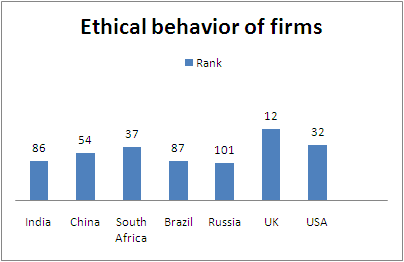
Ethical Behavior of Firms

Ethical behavior is assessed by company policies on bribery, kickbacks, protection money, facilitation payments, gifts, fraud, money laundering, and political and charitable contributions. Management systems and procedures outlining frameworks for risk assessment, sanctions, whistle-blowing, continuous internal self-review and external reporting also fall under the purview of ethical behavior. In 2013, South Africa ranked at No37 on ethical behavior, ahead of other BRICS nations, with China at a distant 54th rank. India & Brazil ranked 86th and 87th and Russia ranked the lowest among BRICS nations on this parameter.  
Source : Global Competitiveness Report WEF 2013
   

Strength of Auditing and Reporting Standards

Fair practices and transparency in dealings are critical to attracting foreign investments. 

Monday, 24 March 2014

Corporate Social Responsibility in India - Transition from Moral Imperative to Mandatory Expenditure


Mandatory spending on Corporate Social Responsibility is the new reality for Corporate India. The enforcement of this provision from April1, 2014, has shifted focus from the debate on whether CSR is a moral imperative or not to how companies can put the mandatory CSR expenditure to effective use.

The provision of the Companies Act 2013, mandates that any company with a net worth of at least Rs 500 crore or a turnover of Rs 1,000 crore or a net profit of at least Rs 5 crore would have to spend at least 2 per cent of its average net profit of the immediately preceding three years. According to the norms, the CSR activities will have to be within India wherein companies can choose from a range of activities such as promoting preventive health care and sanitation, setting up homes and hostels for women and orphans and livelihood enhancement projects. If a company is unable to spend the amount, an explanation will be required in the director’s report.
.
CSR_Lead Essay.indd

As a result of this provision, many corporate enterprises are stepping up their CSR efforts. However the fact is that many companies still lack the processes to channelize the allocation of these funds. For instance, in its report on CSR activities of Coal India, the parliamentary panel on coal and steel mentions that  “Of the allotment of Rs 553.33 crore in 2011-12, Coal India and its subsidiaries could spend only Rs 82 crore (14.8 per cent). Coal India sources said the failure to meet the target was more on account of procedural delays rather than lack of funds and initiative on its part.

Corporate entities will now have to reorient their CSR spending under the provisions of the Companies Act 2013.and set up processes and mechanisms to ensure that CSR funds are directed to productive uses and prevent unethical and inappropriate funneling of CSR funds for private purposes.
Additionally companies will need to expend management time and resources to set up processes for:
  • Creating transparency and accountability in the utilization of CSR funds.
  • Identifying CSR initiatives that are synergistic with company strategy.
  • Conducting due diligence for effective utilization of funds in creating value for society. For example when the funds are earmarked for towards projects for creating some new facility (say a medical center) it makes sense to check if there are pre existing facilities in the area that can be augmented effectively instead of creating new facilities.
  • Gathering knowledge of similar/ duplicate initiatives that other companies might be launching concurrently.
  • Collaborating with other organizations that can effectively utilize CSR funds for socially relevant purposes.

Industry bodies can help in the coordination of CSR activities by sharing information about CSR initiatives shepherded by different NGOs or companies. This could also lead to setting up of social enterprises with expertise to undertake CSR initiatives for companies or funds fund to pool CSR resources for a fee and make sure the corpus is spent intelligently.
 Undoubtedly, CSR gaining traction in the corporate sector is a step forwards towards corporate participation to bring about inclusive growth and sustainable development to aid India’s transition from a developing to a developed nation.


References:

Monday, 6 January 2014

CAG audit of private telecom companies - Governance or Interference?


CAG auditIn a verdict yesterday, the Delhi High Court allowed the Comptroller and Auditor General (CAG) of India to audit the accounts of private telecom companies under the Telecom Regulatory Authority of India (TRAI) Act.

This his kind of ruling was unthinkable even a few years back as CAG was and is still largely seen as an auditor of companies owned by the government.

As natural resources such as spectrum, gas/oil fields, coal, etc cannot be easily priced,  the government has a big stake in these sectors and many of these companies that are involved in the production sharing of natural resources or profit sharing from natural resources  enter into a public-private partnership (PPP) with the Government of India, so it appears logical that industries and sectors that deal with precious natural resources come under the ambit of CAG.

CAG doing audit of such private companies will have the several ramifications on the overall dynamics of the industry.
  1. It will expand the role of the institution and may influence the auditing methods followed in companies. CAG will aim to check if there are any efforts to pad up costs or any instances of loss of revenue to the government where the private players have enjoyed profits that ought to have gone to the government. Their audit report will be as valuable for the investors as the external auditor's report. There might also be some conflict with the Income Tax Department if CAG checks the accounts and find cases of discrepancies in the tax payments.
  2. Though the audit is to pertain to the audit of receipts, but to do a fair audit CAG may demand access to information such as top-level deliberations and decisions or the minutes books of the board of directors.  While the CAG may see this as governance, companies may construe it as excess of interference. CAG may form an opinion depending on the information that it comes across during audit and ask companies to provide suitable justification for any expenses that they might have incurred but not shown in the books. According to the Principle of Materiality companies only need to include significant or material expenses in the accounting statements. Non material expenses that are either small or are not significant are not included in the books of accounts.
    Any unresolved difference of opinion between CAG and companies on materiality of accounts could negatively impact the companies. Theoretically a company should not run into difficulty if a reasonable return is guaranteed vide the framework. But if any inefficiencies are highlighted , then it could result in fine being levied, and which may impact the bottom line of the companies and may result in deterioration in the quality of services being provided as the company runs into difficulties.
  3. Many decisions could come under the scanner including those involving procuring spectrum at low prices and selling them to foreign players at windfall gains , thus shifting the gains from government to private players and other revenue sharing details.  It could also lead to CAG fixing accountability by inferring omission and commission if they do not get information to their satisfaction.
  4. In any public company it is the responsibility of the Board of Directors to select and approve the auditors  to ensure fair audit and share the findings of the audit with the stock holders and financiers. With CAG conducting a separate audit, there is a possibility of some change in the power equation of the Board.
This ruling also shows that changes do start taking place albeit gradually when there is an erosion of confidence in the system or in certain institutions.

What do you think? Do share your views. 

Wednesday, 11 September 2013

Shareholder Engagement or Activism ?

Continuing from my last post ‘Is shareholder engagement good for companies?’, here we look at the scope of shareholders engagement and different approaches to shareholder engagement.

What is the scope of shareholder engagement? 

Shareholders have a legitimate role in areas pertaining to
  • Corporate Strategy – such as mergers, diversification, restructuring, non core asset sale.
  • Capital Structure – such as capital allocation discipline, use of cash on balance sheet.
  • Governance – such as audit-related issues, board structure, managerial remuneration
However shareholders are not expected to micromanage companies. Nor is it desirable that shareholders push for short term profitability over sustainability and long term value creation. It is important that shareholders and board members engage effectively in the shared pursuit of high quality governance.

What are the different ways in which shareholders engage with companies?

Shareholders can either have a proactive approach for engagement with a company or may adopt a passive approach towards a company.


 Passive investors sell off their shares if they are dissatisfied with the corporate decisions.
On the other hand, active investors engage proactively with the management, prior to a corporate decision being affected, in order to change the outcome of the decision. While the term ‘shareholder engagement’ is used to describe a collaborative approach, ‘shareholder activism’ refers to the use of a more assertive approach by the minority shareholders to affect changes in management and strategy of a firm.
The approach to shareholder engagement varies in different countries.  Depending upon the business environment, legal contexts, and their own investment objectives, shareholders may adopt a collaborative, confrontational or mixed approach. Institutional investors like mutual funds and pension funds who tend to hold onto their investments for long-term returns adopt a cooperative approach with management, whereas hedge funds, with short term objectives, may adopt a more confrontational approach. Some countries provide more legal tools for shareholder activism than others. For example in UK, shareholders have a greater influence in questioning management activities and dealings than in the US. 

Global trends and practices in shareholder engagement 

Some global trends and practices in shareholder engagement include 
·         Disclosures.
·         Shareholder voting.
·         Shareholders say in appointment of auditors and directors.
·         Shareholders say in remuneration of the directors.
·         Shareholders’ approval of related party transactions.
·         Class actions that allow a group of investors with common interest in a matter to sue the management of a firm, its auditors or a section of shareholders in case of suspected wrongdoing.
·         Shareholder engagement through proxy advisory firms that analyze corporate proposals placed for shareholder approval and give their recommendations regarding the proposals.

While there are different ways in which shareholders engage with companies, shareholder participation in corporate affairs remains a function of business environment, legal contexts and ownership structures of companies.


Thursday, 5 September 2013

Is shareholder engagement good for companies?

Shareholder activism has increased significantly in the last few years, particularly after the financial crisis of 2008. However, it has since then been it has been a debatable topic, as it is difficult to quantify “appropriate” level of shareholder engagement, which is desirable for achieving effective governance, while adding to business value. Quite often there is an apprehension that excessive shareholder intervention may consume a lot of valuable management time and result in short term profit orientation. 

Why should shareholders engage with company management and boards?

A business needs capital to finance its growth Shareholders are the providers of capital to a business and as such are part owners of the business. Shareholders invest in the business hoping for a higher potential return from the investment, while accepting a greater potential risk than other providers of capital. As shareholders own a share of the organization in which they have invested, this entitles them to ownership rights (i.e. rights to profits and assets in proportion to their shareholding) and in most cases control rights (i.e. rights to have a say in the running of that company, e.g. they may vote on key issues).


Image Source : http://ventism.blogspot.com
Management makes use of the capital to run the business and has an obligation to do so in a fair and transparent manner while maximizing value for the shareholders. However in practice management may take actions that benefit themselves, at the cost of dispersed shareholders, who are not involved in the day to day operations of the company. 
The board of directors oversees management to ensure that it is allocating capital appropriately. As a result, the board has a responsibility towards all the shareholders of the company to represent, manage and protect their interests in the company. Shareholders engage with company management and boards to ensure that their interests in the company are protected. If shareholders are not satisfied with the performance of the directors, they may remove the directors or refuse to re-elect them.

Can all shareholders influence corporate decisions?

All shareholders are not alike. Shareholders can be either private individuals or large corporations such as mutual funds, hedge funds, bank trust departments, insurance companies or private equity funds.Due to the differences in their portfolio types, investment objectives, nature of information available to them and their ability to influence the management, different types of shareholders have different priorities and motivations for engagement with companies. Where promoters are the dominant shareholders in the company, they have substantial power and control over the enterprise. Minority shareholders being dispersed, generally lack the resources required for coordination and active engagement with the companies. In contrast, the institutional investors are often in a position to exercise considerable influence in corporate decisions. 

Is shareholder engagement good for companies?

Though there is no empirical evidence about impact of shareholder engagement / activism on long term performance of companies but it is believed that effective shareholder engagement does help in strengthening corporate governance practices within companies. Board-shareholder engagement gives companies a better sense of shareholder concerns and allows them to gauge shareholder interest on significant proposals. Reliable information from companies, transparent disclosure policies and insight into management’s priorities, allow investors to balance risks and to allocate their capital accordingly. In turn, better governance practices augment the companies’ ability to attract risk capital from domestic and foreign investors for funding new or expansion projects. So overall we tend to believe that effective shareholder engagement is good for companies.

In the next article we will discuss the scope for shareholder engagement and different approaches to shareholder engagement.

Friday, 9 August 2013

Companies Bill 2012– Giving Voice to Minority Investors in India

The passing of The Companies Bill 2012 by Rajya Sabha on 8th August,2013,  is a step forward towards transformation in the corporate governance practices of the country. The new bill that requires President’s assent for it to become law, replaces the Companies Act of 1956. The bill, when enacted will bring in reforms to enhance corporate governance by giving voice to the minority investors in India, strengthening the role of independent directors and expanding the responsibility on auditors. 

A key objective of corporate governance in India has been to strike a balance between the rule of majority shareholders and the protection of the rights of minority shareholders. The protection of minority shareholders rights is particularly critical given the often concentrated ownership of Indian companies.

Unlike in the developed countries such as US & UK, where ownership of a company is widely dispersed and is generally separate from the management of the company, In India listed companies are usually parts of a large business group, characterized by a promoter or a controlling shareholder. This pattern of ownership gives rise to potential conflict of interest between the dominant shareholders and the minority investors, since the controlling shareholders have the power and incentive to monitor corporate activities closely and influence or control the corporate decisions in a manner that could be detrimental to the interests of the minority shareholders.

Traditionally the outside (non-promoter) shareholder participation in the corporate decision in India making has been low. The regulatory framework in India was till recently by & large tilted towards redressal of oppression by management and did not encourage proactive engagement of shareholders on corporate decisions. The new Companies Bill 2012 seeks to provide investors with effective means to voice their opinion in corporate matters that may have potential conflict with the interests of the company and the investors at large.  

The bill as passed by Lok Sabha on 18th December, 2012, has the following key amendments to increase shareholder participation in corporate decision-making:


Related Party Transactions


Companies Bill 2012 includes the provisions for approval by the Board of Directors for Related Party Transactions with transaction amounts exceeding prescribed limits or transactions which are not on conducted on market terms. Exemptions apply to transactions that are on ‘market terms’ and are conducted in the ordinary course of the business. The Bill also requires Independent directors to ensure that adequate deliberations are held before approving related party transactions and authorize every contract/ arrangement entered into with a related party, while providing with a justification for it. The Bill also says that no member of the company shall vote on such resolutions to approve any contract or arrangement if such member is a related part.


Exit Offer


Another key provision in the new Companies Bill is that if the minority shareholders feel that the funds raised from them are utilized by a company for a purpose other than those stated by the company in its objects, then they shall be given an exit offer by promoters or controlling shareholders. It will allow the minority shareholders to exit at such exit price, and in such manner and conditions as may be specified by the Securities and Exchange Board of India.


Class Action


The biggest boost for the small investors comes in the form of the provision in the Companies Bill for class-action lawsuits, which will allow a group of investors with common interest in a matter to sue the management of a firm, its auditors or a section of shareholders in case of suspected wrongdoing. A class action suit is a form of a lawsuit where a large group of people collectively bring a claim to court through a representative. The provision for class action in the Companies Bill 2012, will give shareholders an edge in defend their rights, if they are of the opinion that the management or conduct of the affairs of the company are being conducted in a manner prejudicial to the interests of the company or its members.

These measures are in line with the international practices adopted for empowerment of shareholders and will pave the way for enhancement of corporate governance system in the country.


Monday, 13 June 2011

Role of Independent board directors in Indian companies

A recent article in Economic times reveals that following the takeover of scam-hit firm Satyam by Tech Mahindra in 2010, Mahindras are now contemplating to sue the company's erstwhile independent directors to recover Rs 11 million paid as commission to non-executive directors during the financial year 2008-09. Each of Satyam's former independent directors were paid a commission of Rs 12 lakh over and above sitting fees for the financial year 2008-09.

The independent directors of Satyam included renowned people like management guru Krishna G Palepu, Pentium chip innovator Vinod Dham, former Indian School of Business dean Prof Mendu Rammohan Rao, former cabinet secretary TR Prasad, former IIT Delhi director V S Raju and US-based academician Mangalam Srinivasan. It is ironical to note that in the presence of such eminent independent directors, the company’s founder Ramalinga Raju could manage to fudge the company's accounts for several years. This brings into question the role of the board, independence of the so called independent directors and the equation that they share with the company’s management and other stakeholders.
The corporate governance systems in different countries vary depending upon the legal set up, social and cultural values, and the structure of capital markets. The shareholder centric model of corporate governance in US and UK was created based on common law, which associates an equal or even higher weight to past precedential court decisions on similar cases, as to the statutes passed by legislative bodies. In the Anglo Saxon model followed, a unitary board of executive and non executive directors serves as the controlling mechanism to ensure that management act in the interest of shareholders of publicly traded corporations and pass on the profits to them. The corporate environment in India is very similar to that in the UK, having been built from the legal foundations and legacies of the UK. India is pre-eminently a common law country with a well developed system of law and justice. Similar to the UK and the US, the Indian regulations focus on the role of the board as the bridge between owners and management.
Taking into account the existence of concentrated and controlling shareholders in India, the amended Clause 49 of SEBI guidelines seeks to moderate this particular influence by the presence of majority of independent directors. Clause 49 requires that at least half of the board directors should be independent in companies where chairman is an executive and one third of the board directors should be independent in companies where chairman is a non- executive. Why is it that in spite of majority of independent directors, the Satyam boards of directors acted as silent spectators and were largely ineffective in monitoring the actions of management? To some extent to this behaviour can be attributed to the process through which the directors come on the board. The directors are generally brought in by the promoters and management; therefore they could look upon themselves as having responsibility to the promoters rather than to the outside shareholders. As a result, the boards of directors may remain passive or largely function as mouth- speak of the management.
In India, family run companies continue to dominate the corporate landscape. In most family controlled businesses, the managerial control of the business is often in the hands of the members of the family, who either own the majority stake, or maintain control through the aid of other block holders like financial institutions. The interests of the promoters, who are the majority shareholders, need not coincide with those of the other minority shareholders. This can lead to expropriation of minority shareholder value through actions like “tunneling” of corporate gains or funds to other corporate entities within the group. Under such circumstances, the directors who are friends and allies of the promoters may opt to confess incompetence and ignorance rather than to disturb the family based governance structures of Indian companies. When Dr Rao, the dean of the prestigious BSchool resigned from Satyam board, he was reported to have acknowledged of having no prior knowledge of the scam and was said to be stunned by the revelations of Ramalinga Raju.
Such instances of failure in corporate governance highlight the need for more changes to the existing systems. While the corporate governance framework established in India is robust and in principle as effective as those of the UK and US, the effectiveness of enforcement of the framework still remains an interesting empirical question.