Thursday, 26 June 2014

8 Skills That Will Make You An Effective Leader


'Mostly leaders are born. Some inherit leadership. Some come by default.' These statements coming from an acquaintance on social media induced me to write this post.

When we think of leadership, traits such as charisma, authority, courage, oratory skills easily and instinctively come to our mind. These qualities are associated with great leaders or inspirational figures such as Margaret Thatcher, M. K. Gandhi, Martin Luther King Jr.or Churchill and most these seem to be inborn qualities.

It goes without saying that not all of us can have the style, presence or oratory skills of these great historical figures. Just like some people are gifted singers, while many others struggle to strike the right notes, some people are naturally bestowed with a charismatic persona, while others are not.

Does it mean that in absence of inborn leadership traits, one cannot be a leader? Let us dig into it a bit more. Here I list down 8 key traits of leaders, in an attempt to identify which of these leadership skills can be developed. 

                                       .  .


 1. Clarity of Purpose


A purpose can change a life from ordinary to extraordinary. 

Only an individual with clarity of purpose can inspire, motivate and align people with his vision. This key leadership quality can be attributed to a great extent to the situations that a person is exposed to and how one reacts to them. Some people, albeit a few, find their calling at a young age. However, for most of us, it may take ages to figure out what the purpose in life is and many of us may never find it at all.
This, however, is not a reason to fret about.

In absence of a greater cause or purpose in life, you can still set goals that serve as anchors and devise some philosophy that makes life meaningful.

Click To Continue Reading

Saturday, 21 June 2014

Unique Expressions of Art


Warli Wall Art Festival, 2014.

Wall Art Festival  aims at promoting sustainable international cooperation through the Power of Art. The walls of a primary school in Warli were used as a canvas on which two artists, one from India, the other from Japan, made paintings on the majority of the wall in two separate classrooms.


Sculpture of San Francisco created with toothpicks.


Whimsical, Unique Stone Sculptures by Japanese artist Hirotoshi Ito.


Sunday, 15 June 2014

India’s MIT - Making A Mark In Higher Education


Akin to Darwin’s theory of ‘Survival of the Fittest’, admission into the premier public institutes in India is about 'Survival of the Brightest'. With the scores in board examinations soaring as high as the mercury levels in most parts of the country, both students and their parents feel the heat as competition for admissions into colleges gets tougher.

A score less than 90% is unlikely to fetch a student, a seat in the general category, in a premier public institute. Even so, a score above 90% alone does not suffice for entrance in most of the leading public engineering institutes, where selection is determined by the combined board score and score in the Joint Entrance Examination (JEE).

The tough selection criteria coupled with growing number of applicants each year (over 1.3 million students registered for JEE in 2014) leaves many meritorious students missing the mark to secure a place in the publicly funded institutes. Into this void of demand and supply, have stepped in some private engineering institutes that aim at providing quality education to the students.

Traditionally higher education in India has been the forte of government owned institutions and people have generally been skeptical about the quality of education imparted by the private universities. However the perception seems to be changing. The change somewhat accelerated in this year 2014 itself, after it became common knowledge that the CEOs of two of the world’s most famous technology brands, have graduated from a relatively modest private engineering institute in India.

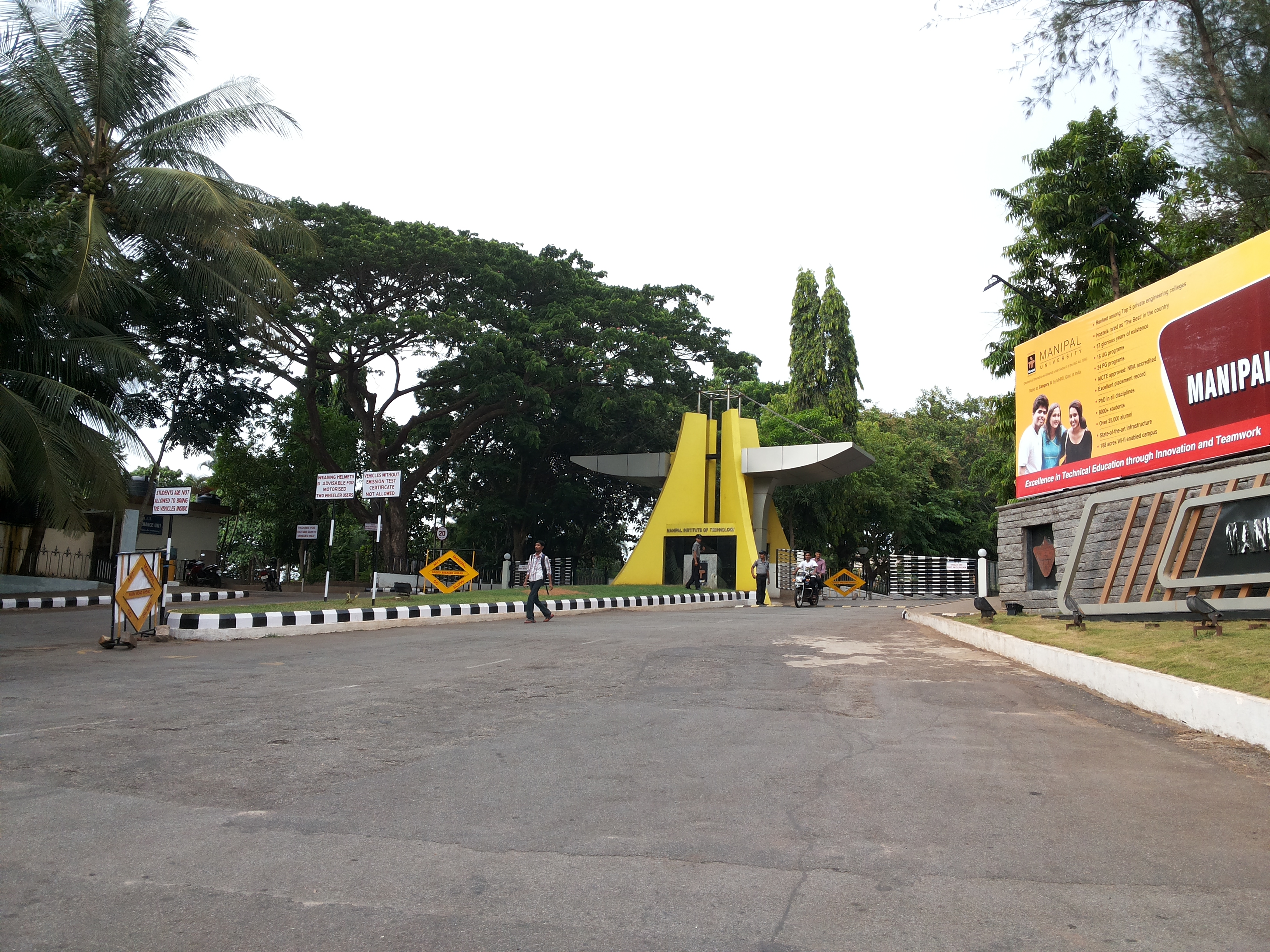
Manipal Institute of Technology (India’s MIT) came into limelight this year as the alma mater of both Satya Nadella, the CEO of Microsoft and Rajeev Suri, the CEO of Nokia.

A visit to the MIT campus last week when I accompanied my daughter for the counseling session for B Tech admission put any remaining doubts to rest.

Located near Udupi in Karnataka, MIT is at a distance of about 60 kms from the Mangalore airport. On the way from the airport to Manipal, the scenic rolling topography, greenery and serenity of the place soothe the eyes and mind.

A large poster at the entrance of the campus with images of the illustrious alumni catches our attention. The MIT campus is a part of Manipal University which is a unique university town by itself. Education drives the economy of the place. The small town with a population of around 35,000 is home to nearly 28,000 students pursuing courses in various disciplines including medicine, engineering, management and humanities.

20140606_17100520140606_170838

Founded in 1957 by Dr TMA Pai, MIT is one of the first self-financing engineering colleges in the country. The campus is spacious, clean, green and self sufficient with Engineering blocks, laboratories, innovation centers, library, separate hostels for girls and boys, a spacious food court, cafeteria, bookshops and small shops for other necessities. Infrastructure is excellent; the campus is Wi-Fi enabled and air-conditioned lecture halls are equipped with hanging projectors. About half a km away from the campus is Marena, a large the indoor sports arena that provides world class sports facility to the students and staff of Manipal University.

Counseling sessions are transparent and well organized. Real time status update on allotment of seats show on big screens in the lecture halls where the counseling sessions are conducted. The status is made available on the college website at the end of each session. No one seems to be in a rush and yet everything gets done efficiently and on time.

Dr Murthy, a senior professor at MIT is kind enough to guide us around the campus. We meet Director Dr Vinod Thomas and Joint Director Dr Srikanth, who come across as warm and very down to earth people. The professors, head of departments have mostly graduated from the IITs or NITs. They appear genuinely interested in getting to know the new students as well as their parents. I find it reassuring to know that children of many of the professors are studying in the institute; it speaks volumes about the amount of confidence they have in their institute. The placement statistics too are good with close to 80% students getting placed in companies recruiting from the campus. Above all, the place seems safe for girls, which addresses a big concern for most parents.

Hopefully the coming years will see more such smart universities emerging in the private sector to cater to the growing demand for higher education in India. Engineering and management institutes such as Nirma University of Science and Technology, Vellore Institute of Technology, Dhirubhai Ambani Institute of Information and Communication Technology, ISB and Symbiosis are already making their mark.

Monday, 9 June 2014

Two Interesting Historical Facts


I came across these two articles with historical facts presumably unknown to many, as they were to me, so found them worth sharing.
As a whole lot of information is shared on Twitter, I am adding this section 'TweetBits' (on the Menu) to include some of the informative and interesting tweets. Retweet is possible from the included tweet itself.

Britain has invaded all countries in the world barring 22 countries at different points in time.


Contrary to the common belief that the British rule extended to a quarter of the atlas, a study indicates that barring 22 countries in the world, all other countries have experienced an invasion by the British at different points in time.
Among the select group of nations that have never been invaded by Britain are countries such as Guatemala in Central America, Bolivia, Paraguay in South America, Mali, Chad, Congo in Africa, Monaco, Vatican City, Luxembourg, Sweden in Europe, Tajikistan, Uzbekistan, Krygyzstan and Mongolia in Central Asia .
The analysis is contained in a new book, All the Countries We’ve Ever Invaded: And the Few We Never Got Round To , written by Stuart Laycock. The complete article is available on http://goo.gl/gVS2Rm.

World War 1 propaganda maps in pictures


The use of caricatures and cartoons in World War 1 propaganda maps show how cartography can be turned into a rhetoric of war.
In this map, Great Britain, personified as a muscular John Bull, is shown striding across the English Channel to to take charge of Europe in a colourful map of first world war propaganda. The map was published in London at the outbreak of the war, and was intended to show confidence that Germany and its ally Austro-Hungarian empire would be defeated swiftly by the combined might of Russia, France and the British empire.
The complete article can be found on http://goo.gl/d781U1.


References:
http://worldobserveronline.com/2012/11/09/british-invaded-nine-ten-countries-look-luxembourg/
http://www.theguardian.com/books/gallery/2014/jun/03/war-ww1-propaganda-maps-in-pictures


Friday, 30 May 2014

‘The Flaws In Our Laws’ By Dr Bibek Debroy | Absurdities Of Indian Laws – Part II


Continuing from my last post ‘The Flaws In Our Laws’ By Bibek Debroy | My Scribbling Of The Session – Part I, here I proceed to  jot down the next two anecdotes that were also the most interesting anecdotes of the session.
.

Identifying Surplus Government Posts


Anecdote 3 was about identifying redundant government posts to recommend their abolishment.
The story, as narrated to Dr Debroy by a retired senior civil officer goes as follows…
In 1973, an Administrative Reforms Commission was set up in Tamil Nadu to find posts in the system that appeared to be redundant. Two such posts identified were that of LBK, LBA. Nobody seemed to have a clue about what these abbreviations stood for, nor about the duties assigned to these posts.
Some facts unfurled when people who had retired from these positions and were drawing pensions were called upon to enquire about the posts.
In 1926, a Royal Commission on Agricultural Reform was set to improve the quality of agriculture in India . The Commission was set up under the Chairmanship of Lord Linlithgow, who later became the Viceroy of India and served from 1936 – 1943. It was decided by the Commission that agricultural productivity would be improved by improving the quality of Indian cattle by breeding Indian cows with foreign bulls. The system was as slow then as it is today, maybe much more slower. Nothing moved on the recommendations of the Royal Commissions.
Ten years on, in 1936 when it was announced that Lord Linlithgow would be the new Governor General, things suddenly stirred up in the system. The new Viceroy would certainly want to know what had happened to his recommendations.
In the government system, creating new positions is just as difficult as slashing jobs. So to get things moving, two job positions were created by invoking the name of Lord Linlithgow . The position LBK stood for Linlithgow’s Bull Keeper, who was assigned with the task of overseeing the import of bulls, while LBA’s (Linlithgow’s Bull Assistant’s) job was to ensure that cows were impregnated at the right time.Bull
As we were in splits of laughter, he added that though these posts were abolished in the early 1980s. Yet there was another post that still continued past the 1980s.
This was the post of Churchill Cigar Assistant.  The World War II had disrupted the supply of cigar from Havana. The Prime Minister of Britain, Mr Winston Churchill loved his cigars, and so his housekeeping staff looked at the possible alternative supply of Trichy cigars from India. Churchill Cigar Assistants were appointed to source cheroots from Trichy and supply them to Britain for consumption of Mr Winston Churchill.  The post continued to remain long after the supply of cheerots from Trichy to Whitehall had stopped.
CCA
As we lapped up the anecdotes, Debroy proceeded to the next one.


The Dead People’s Association 


Anecdote 4, the most interesting of all was about Mritak Sangh (Dead People’s Assosiation)

This is the story of Lal Bihari from Uttar Pradesh, who was declared dead on government’s revenue document after his relatives bribed the officials  and announced him ‘Dead’ to usurp his ancestral piece of land.
He tried everything to prove himself alive – from pelting stones at Police Station in the hope of being arrested and thereby forcing the government to acknowledge his existence, to claiming a widow pension to his wife, hoping they would rectify the mistake upon seeing she was still married to him. But nothing changed. Any number of attempts made by him to prove that he was alive proved futile.
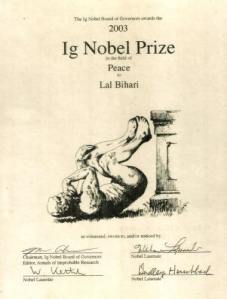
In the process he discoignobelvered that there were around 20000 officially dead people in India. Having lived for a long period as a dead man alive, he made a resolve to help other landless individuals in their fight to prove themselves ‘Alive’ and thus he formed the Mritak Sangh[i] .
In 2003 Bihari was awarded the Ig Nobel Peace Prize– a parody of the famous Nobel Peace Prize for his widespread altruistic “posthumous activities [i].
While this anecdote had people in splits of laughter, it also clearly revealed the vulnerabilities of the Indian Legal System.


Like a master storyteller Bibek Debroy proceeded on to tell us about the large number of state level statutes that existed in India, old archaic laws some dating back to the 19th century and Pre independence days that are no longer the least relevant, the Sarai  Act, Hackney Carriage Act in London and some other anecdotes.
The Q & A round followed.  His answers delved into specifics of the Sections & Clauses wherever needed.
By the end of the session it was obvious that the Dimensions of Legal Reform in India are numerous. It was also apparent that while a Lawyer would focus more on the redressal of injustice occurred, an Economist’s view of the legal system is more oriented towards mechanisms for prevention of flaws in future.
It was undoubtedly a very enlightening session. Dr Bibek Debroy used a common sense approach throughout to drive down the points and share his profound insights. It was an enriching experience for me and I personally felt that this lecture was completely at par with the lectures delivered by some of the world’s best B School professors, that I have had the privilege to attend.
Thanks to MoneyLife Foundation for giving us this wonderful opportunity to listen to a great speaker. It was definitely an opportunity NOT to be missed.

References

‘The Flaws In Our Laws’ By Dr Bibek Debroy | Absurdities Of Indian Laws – Part I


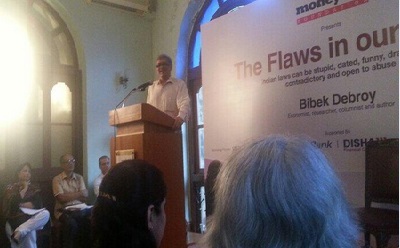
On rare occasions, it happens that a person can dig into a complex topic with remarkable ease and make perfect sense to a diverse group of listeners, while capturing their attention all along and making the subject exceptionally interesting.  Dr Bibek Debroy is certainly one of those people blessed with such rare ability. Fascinated by his knowledge on the vast array of subjects he tweets about, I had registered for the seminar arranged by MoneyLife Foundation, to hear Dr Debroy speak on the Flaws in Indian Laws.
I reached the Royal Bombay Yacht Club just 5 min before the start of the event. The building is just at a stone’s throw from the Gateway Of India and has an old world charm about it. With hardly any time in hand to appreciate the architecture, I rushed into the hall and yet found myself seated on a single vacant seat on the 2nd row.  And there I was, all set to listen to one of the most interesting sessions by the noted economist, columnist and author.
So the session began. Right from the word ‘go’, it was replete with anecdotes that held the audience in rapturous attention and we found ourselves intermittently bursting into peals of laughter at the absurdities existing in the Indian laws. I am recollecting here some of the numerous anecdotes shared, which I had managed to scribble down.
.
FIL

The Trigger For Initiating A Research Project For Legal Reforms.


The 1st anecdote was about an unexpected and a seemingly innocuous event that had provided the trigger for initiating a research project by the Government Of India for Legal Reforms.
The story goes back to the year 1993. One day Dr Ashok Rudra, a scholar, economist and professor at Vishva Bharti invited Bibek Debroy for lunch to ask about his interest in heading the research project. He gave him the time between the start of lunch & dessert to make up his mind.
The project was approved by none other than our ex PM Dr Manmohan Singh, who was then, the Finance Minister Of India. Mr. Shankar Aiyar, a noted journalist analyst and author of the book ‘Accidental India’ had inadvertently provided the prompt for the project. 
It happened so, that Shankar Aiyar was invited to France to speak on a conference. The per diem allowance in those days was $65. Shankar Aiyyar found the amount less and wanted his allowance to be increased to $100. He put up an application to Mr. S. Varadachary, who was then, the Joint Secretary in the Ministry of Finance. Varadachary must have seen some merit in the request, and thought it should be extended to all others as well. However, that called for making a modification to the Foreign Exchange Regulation Act (FERA). The matter was then taken to Mr Ashok Desai , the Chief Economic Consultant, who thought it made sense to scrap FERA and come up with a new version with changes in all other areas, wherever needed. He discussed the proposition with Dr Manmohan Singh, who agreed and further suggested that a research project be carried out for Law Reform to identify all areas that needed to be amended.
So began the search for a person who could undertake this project. In this context Ashok Desai contacted his friend Ashok Rudra, who then took Debroy for lunch.
Of course, the answer was yes and thus started a Project for Law Reform in collaboration with the National Law School Bangalore with support from Mr Madhav Menon, the founder-director of the law school. The Project was to continue for 4 years and resulted in many interesting findings and suggestions. How many of the suggestions were implemented, is a different question though.
With narration of this anecdote, Dr Debroy had managed to catch the attention of the listeners. He quickly moved on to the 2nd story.


The Longest Standing Litigation in India.


Anecdote No 2 was related to the longest standing litigation in India.
When Bibek Debroy started to look out for the longest standing litigation in India, he could not get any satisfactory answers to this question from any lawyer, or any pertinent information in this matter.
Finally a search in the Guinness Book of World Records revealed the longest standing litigation as one that dated back to 1205. The case was filed by a member of a certain Korat family in Ambegaon in Pune and it involved a litigation about which family branch should get the right to worship the family shrine. Spanning a period of 761 years, this certainly qualified as the longest standing litigation in the country (maybe even in the world).
As the word about this longest standing litigation spread around in the newspapers, Debroy received a letter from a certain Mr Narasimha Reddy pointing out that though the history of this dispute dated back to 1205, the dispute was with the court from 1964 to 1966 and was settled in a period of 3 years. To substantiate his claim, Narasimha Reddy mailed all records of the case, which he had personally collected, to Bibek Debroy. Amazed by his interest in digging out the facts and files pertaining to the case, Debroy asked Reddy what had prompted him to travel all the way from his residence in Hyderabad to Pune to collect the records.
The reply was equally amazing. “I have filed for the record of the longest standing dispute from 1945 – 1990, a span of 45 years to Guinness Book of World Record”, said Reddy. Obviously it was in his interest to see that no case surpassed the duration of his litigation.
Unfortunately for Narasimha Reddy, The Guinness Book had either discontinued that category of records or did not want to include any cases from India wrt this category. So he had to be content with an entry in the Limca Book of Records.
Thus stood the case of the Longest standing dispute.
We were all ears and hungry for more.
I later did a google search and found that a litigation over a disputed graveyard in Varanasi has been going on since 1878. This supersedes Mr Reddy’s record.
I stop here now to keep this post short and continue with the other anecdotes in my next post.


Including here comments received from Dr Bibek Debroy. I seem to have mixed up a few names.
FIL1

Sunday, 25 May 2014

Reinventing Winning Ways | How To Reorient To A Process Driven Approach


Reinvention seems to be the buzzword of the season. With India’s Elections 2014 over, the need for reinvention has resurfaced with vigor. In light of the dismal performance in elections, some parties have dissolved different committees on grounds of non performance to rediscover winning ways. Questions have surfaced on whether political parties can reinvent themselves. Suggestions for restructuring the ministries to reduce multiplicity of government departments and bring about effective governance have been put forth for the new government by the specialists.
At this juncture, when people are expecting India to take on the path to economic recovery and international brokerages are betting high on India’s growth story, the time is apt for many institutions to start the process of reorganizing themselves. Needless to say the magnitude of efforts and change required will be humungous.
One of the essential elements in the process will be a shift from a reactive or inaction based approach to a ‘process based action oriented’ approach. That, in itself, is a challenging task as it requires a huge shift in the mindset at all levels – starting from the highest and percolating down the ranks; though a somewhat obvious statement, this is seldom spoken about. Nonetheless, a shift in mindset and approach is necessary to bring about even the small changes, or for that matter for plucking the ‘low hanging’ fruits.

Change4
The challenges are aplenty. In our society which places a premium on hierarchy and individual merit, following a process is not something that people eagerly look forward to. Not very infrequently, we see that people in the top rungs are considered above the processes that are meant to be followed by all. The perception that following processes undermine authority and impede creativity often translates into a reluctance for adherence to processes. Furthermore, there are many who tend to think of themselves as creative and smart by overriding processes, even in things as simple as having to pay a small fine for breach of traffic rules or by managing to get away without paying for services availed.
A process, by definition appears restrictive, even if necessary. We think of processes as bureaucratic routines that have to be adopted and adhered to. For reasons unknown these seem to be designed to slow down rather than facilitate the work. Unlike in a creative work, where a person derives intrinsic satisfaction from the work itself, there is no intrinsic motivation for following a process. Most of the times there is no appreciation either, because it is what a person is expected to do anyways.
All these put together result in the display of utter disregard for processes, at times, even in the highest institutions of the country, as was recently evident in the transition of PMOINdia twitter account. Needless to say it creates confusion and chaos, and the consequences are undesirable for all.
The importance of processes certainly cannot be undermined. As a matter of fact, the significance of having efficient processes in place cannot be emphasized enough.
Robust processes are needed in banks and financial institutions to detect & prevent fraud and manage risks. Businesses, as they grow, need to optimize different functions such as production, supply chain, customer service etc. Processes are implemented to bring about efficiency, ensure safety and quality, reduce wastage and pilferage, be consistent in dealings with customers or vendors and so forth. Any government needs to have efficient institutional processes to effectively implement their policies in a consistent manner.
Efficient processes bring about consistency in experiences, cut down ambiguity, fix accountability and ensure predictably in outcome. By following processes we can achieve desirable outcomes with optimal efforts, whereas the lack of processes can create uncertainty, discontent and dissatisfaction.
A structured approach towards process management entails designing processes keeping in mind the goals or the ‘To- Be’ state, charting out the ‘As Is’ state and finding out optimal changes needed to bridge the gap under different scenarios. Also taken into consideration are the different stakeholders and their oft-conflicting objectives, organization structures, the boundary conditions and the assumptions. The process once designed is revisited at a determined interval to accommodate any changes to the assumptions, structures or objectives. Change management is needed all along to secure buy in from all those who are impacted by the process.
Since the incentives for adhering to processes are not always very apparent, it is imperative to figure out ways to motivate and incentivize people to follow processes. This requires thorough communication from the highest levels so that people align with the vision and understand how they are contributing to the vision.
The challenge also lies in designing processes in a way that may allow people to express themselves creatively, while being in sync with the overall objectives and ensure that people do not get bogged down by bureaucratic procedures.
creative
A case in point is the innovative campaigning process during the elections that unleashed creativity in people and triggered off a chain reaction by inspiring people to come up with all possible combinations of the ‘Ab Ki Baar..’  slogan. Of course such exceptional demonstration of creativity will not be possible for all processes, however with some effort processes can be made flexible to allow for individual expression of creativity to the extent possible.

It is, however, important to ensure that demonstration of creativity does not lead to deviation from the objectives of the process, impede the work of others or create conflicting outcomes. An example that readily comes to my mind is that of ‘creative accounting’- the term coined to refer to the practice of systematic misrepresentation of reported earnings and assets of companies through concealed irregularities in the accounting processes.
The renewed zest for reinventing winning ways serves as a reminder that it is time for our government and institutions to reorient to a process driven mindset and not let individual hubris defeat the overall purpose of the process.