Showing posts with label Organizational Behaviour. Show all posts

Thursday, 22 January 2015

8 Theories of Motivation that underscore the drivers of behaviour

By Bhudeb Chakrabarti
Good leadership consists of motivating people to the highest levels by   offering them opportunities, not obligations.  ~ Lao Tzu 

Nature of Motivation

Motives are expressions of a person’s needs and personality.

Even though you may find it comforting to believe that all your actions are a result of conscious deliberation, but at times, unconscious motivations may lead to actions without your complete awareness or understanding. Your behaviour is controlled on many occasions by external forces, though on many other occasions you may do things based on your discretion, for their intrinsic value.
Motivations are not static in nature. A person may be motivated for one job but when he or she is put for some other job, the same person may not feel motivated. The levels of motivation also vary from person to person.
A leader must understand what gives people the impetus to act in a particular manner to achieve alignment of their goals with his/her own goals.
if-your-actions-inspire-others-to-dream-more
If your actions inspire others to dream more, learn more, do more and become more, you are a leader. - John Quincy Adams
Different theories help us to understand better the concept of motivation:

Saturday, 20 September 2014

Why some companies in India are still on a 6 day work week

By Somali K Chakrabarti

Working for 6 days a week is never a particularly appealing idea. Most people would agree that a single Sunday is not enough to wash away the fatigue of working throughout the week.

Till recently when my spouse had a 6 day work week, life outside of work was dreary, almost non-existent as the weekends were generally spent on routine household chores, stocking stuff for weekly consumption or for occasionally watching a movie. Others with a 6 day work week would admit to having a similar lackluster schedule.

work weekSurprisingly, now close to 100 years after the 5 day, '40 hours’ work week was first instituted by Henry Ford, to boost productivity among workers, many Indian companies are still hesitant about adopting a 5 day culture.

It is interesting to note that from time to time, number of studies have indicated that working for long hours over a period of time does not increase productivity. Quite the reverse, productivity is supposed to drop beyond 40 hours of work per week (as per a research paper published in 2011, by the International Labour Organization).

Working for long hours over prolonged periods are known to cause strain, fatigue and burn out among the middle aged people, thereby impacting cognitive performance and productivity, shows a study published in the American Journal of Epidemilogy [i].

In wake of the knowledge that productivity does not increase with a longer work week, the question arises :

Why are some Indian companies still on a 6 day work week? 

Continue Reading .......

Monday, 7 July 2014

How Corporate Culture Impacts Gender Diversity At Your Workplace


‘The importance of Gender Diversity at workplace' is one of those issues that are often spoken about in conferences, reiterated in survey findings, and yet seldom are a priority unless there is a mandatory obligation for companies to comply with.

With the exception of a handful of countries such as Norway, New Zealand, Iceland, Australia, Switzerland, Netherlands, Canada, Philippines, women are generally under-represented in the corporate sector in a large number of countries all over the world.

Even in the Tech companies that are known to promote employee friendly culture, diversity remains an issue. Google admittedly has a gender gap, so has Facebook. LinkedIn, too would like to improve its gender diversity numbers says the company's Vice President of global talent, Pat Wadors. Twitter was criticized for filing the I.P.O. without a single woman on the board, subsequent to which it appointed Marjorie Scardino as the first woman director to its board.


What impedes gender parity at workplaces?


Among the factors that hinder gender parity at workplaces, ‘Cultural Inertia’ emerges as a predominant reason that holds back the adoption of gender diversity practices.
In Japan, for instance, women have been identified as the most under-utilized resources. A traditionally conservative country, Japan did not encourage its women to remain in full time employment, notwithstanding their high level of education. Faced with the problem of an ageing population and shrinking workforce, Japan is now waking up to the fact that utilization of women talent pool is crucial for the revitalization of its economy. ‘Womenomics’, a term coined by Kathy Matsui in 1999, now forms a vital component of Abenomics, the set of economic reforms advocated by the Prime Minister Shinjo Abe.

India Inc. too has a long way to go for bridging the gender gap at workplace. In India, while entry is easier and a reasonable percentage of entry level positions are filled by women, the percentage of women declines sharply as we move up the ranks. What happens in between the levels is an oft-repeated story.

Click To Continue Reading 

Saturday, 22 February 2014

Towards Good Decisions


Good decisions come from experience, and experience comes from bad decisions.

Better still if the experience and wisdom are gained by observing the results of bad decisions made by others. However, the fact is that of all the decisions that we make at each and every stage of our life and in our career, only some are good choices.

We are all likely to make bad decisions at some point or the other. And mind you ‘Not all our bad decisions are mistakes’.
.

So what differentiates a bad decision from a mistake?

At times, we are faced with situations where we do not have an idea what the best choice might be. What do we do if we have to respond very quickly and there is not enough time to gather information? In such situations, we make decisions and take actions using our intuitions. As intuitions come naturally to most of us, the use of intuitions helps us to arrive at conclusions rapidly and rather implicitly. However, intuitions are also hardwired with cognitive biases, which substantially influence our thinking. Without these biases and heuristics many decisions would never be made.

Here we need to bear in our minds that while the use of intuitions is certainly beneficial in some circumstances, say where innovative or creative thinking is required, it can also lead to errors in others. In the process we may be prone to making a mistake.

Alternately, there are situations where we make the wrong choice in spite of knowing that it is not really the right thing to do, but we take the risk believing that we will get away with it. If we manage to get away, we do not hesitate to repeat our wrong actions. On the other hand, when we receive flak for our choices, then we try to pass off our bad decisions as judgment errors or mistakes.


decision dice


Owning up a bad decision

As the deliberateness of our action is a key factor that separates a bad decision from a mistake, it is relatively easier for us to admit a mistake, but it is much harder to accept that we have consciously made a bad choice. People are generally more unforgiving towards those who have deliberately acted in a way that was likely to produce a bad outcome.

Dov Seidman, an observer of societal trends in the US, notes that passing off a bad decision as a mistake and rendering an apology has almost become a reflexive response among leaders. Every other day, some chief executive, politician or other prominent figure is seen apologizing for their mistakes.

When a bad decision is re-labelled as a mistake, it no longer appears to be something that is done entirely on purpose. Thereby it reduces the extent to which others perceive the involvement and contribution of the person behind the error and so the person is more likely to be forgiven and the action is more likely to be forgotten.

However the distinction between the mistakes and bad decisions is not always so clear nor is it so simple to arrive at. At times we choose A over B for reasons that we often don’t understand. Our intuitions, cultural biases, emotions and other contextual factors implicitly come into play and fundamentally affect the way in which we gather and process information to make decisions. People are susceptible to think and act in a particular manner due to their cultural orientation. For instance, whereas, we find that the word ‘sorry’ is  one of the most abused words in the US, on the other hand the to say 'sorry' is still an ‘alien’ concept for many unruly parliamentarians in India, who do not regret their display of uncouth public behaviour.

A decision based on perception of ‘what is right’ for the one who makes the decision may not be perceived in a similar manner by others who are impacted differently by the decision. Here the distinction between bad decision and mistake gets blurred.
.

Learning from mistakes and bad choices

Both mistakes and bad choices provide the opportunity to learn and grow from them. The best way to look at mistakes is to use them as stepping stones to move forward towards our goals.

Owning up our decisions is the first step towards improved decisions. We can learn from our mistakes only when we admit the mistake, offer a sincere apology for it and own up the mistake instead of trying to justify the reasons which led to it. Analyzing our mistake by recognizing the situation under which we made the mistake and identifying the wrong action on our part will help to avoid repeating the mistake.

Furthermore, though presence of cognitive biases hugely impact decision making, yet most people are generally not aware of them or like to believe that they are susceptible to implicit biases during decision-making. Recognizing that the biases exist can help us to consciously put some plans and processes in place to address through the biases and balance our intuitions with rationality.

To arrive at better decision outcomes and avoid repeating the same mistake over and over again, we need to work towards:
  • Owning up our decisions.
  • Analyzing our mistakes.
  • Recognizing the situation if it arises again.
  • Remembering the mistake we made.
  • Being aware of our biases.
  • Being aware of likely outcome.
  • Changing our mistake behaviour.

Lastly when perceptions about the correctness or righteousness of a significant decision vary, then it becomes very necessary to assess the impact of the decision of different people, gain buy in of the people who are impacted by the decision, set ground rules and work towards a goal or desirable consequences while acting in appropriate manner to avoid undesirable consequences.

Better awareness will not necessarily guarantee better decisions, but they can make them more likely.
.
References:

Monday, 3 February 2014

How companies can effectively engage employees


Continuing the discussion from my last post on how Employee Engagement can create business value, here  I will write about how organizations can implement a range of workplace strategies to increase the levels of engagement. In this post we look at some best practices relevant to all types of organizations, though the nuances and implementation will vary from setting to setting.

Meaningful work and clarity of objectives

Having a meaningful job is the most important factor that affects levels of engagement for all employee groups. Employees, who are able to relate their tasks to a broader context and feel that they can make a difference have positive perceptions about their work. Where employees can see the impact of their work on the organization or on the customers or on society in general, the level of motivation and engagement are higher.
Work can be made meaningful by
  • Assigning jobs to individuals based on their ability and attitude.
  • Communicating to the employee how the job adds value to the organization and fits into the overall objective of the organization.
.

Senior management communication style and vision

Senior Management can achieve higher levels of engagement by linking the desired organization outcomes to measurable performance drivers. The manner in which a firm’s management structure the organization, shape up the culture and people practices, and create incentives for their employees defines the firm’s ability to use its people to differentiate and compete.
Communication from senior management about organization’s vision and objectives helps employees to understand the overall purpose of the organization and see a bigger picture in their daily work.
Eng1

Management style

Employees’ level of engagement and other work responses are affected by their perceptions of management style. Middle management has a significant role to play in creating an optimal working environment and in helping line managers to support employees in achieving their performance goals. Line managers are the interface between employees and senior managers; as such they need to ensure that the right people are placed in jobs that are appropriate for their skills and abilities. They also need to communicate the goals and objectives clearly, so that employees can focus their effort on specific tasks. This is particularly important in large organizations where there is typically little contact between the senior management team and employees. Articulating the link between individual jobs and the broader organizational aims helps employees to see how their role fits with, and contributes to, the bigger picture of the organizational strategy.
.

Person - job fit

People need to be in the right jobs with appropriate targets to channel their engagement. When people are assigned work for which they have a natural flair and which is in sync with their passions, productivity increases. Employees stand a far greater chance of being able to take on additional work if the work is in tune with their natural talents.
.

Job Enrichment

In some firms employees are moved from their typical day-to-day task to a whole new role, for a limited time to increase the exposure of employees to different functions. This is known as JOB ROTATION. Although this has the advantage of increasing flexibility of production, it does not lead to motivation.
JOB ENLARGEMENT is another technique that involves adding more tasks of SIMILAR COMPLEXITY to the existing job. This technique too does not improve upon the motivational content of the job.
Some organizations provide their employees with opportunities to experience greater RESPONSIBILITY through ENHANCED tasks that require employees to use skills they have not used before, while staying on in the current role. This is known as JOB ENRICHMENT.
Job enrichment involves adding  MORE COMPLEX tasks to a job over a period of time. These new tasks are designed to stretch individuals to utilize their latent skills and abilities by giving them greater responsibility; as well as greater freedom and challenge necessary for self development. These are presented as OPPORTUNITIES rather than demands that  MAY be tackled as an optional extra.
Herzberg claims that while Job rotation and job enlargement fail to motivate because they do not offer the opportunity for growth in the psychological sense, Job enrichment provides the opportunity for the employees' psychological growth.
When introducing Job enrichment , jobs  chosen to be enriched should be such for which MOTIVATION will make a difference. There is no point in attempting to get people to increase their effort unless their increased effort leads to increased productivity. It is observed that employees with high growth needs are more responsive to job enrichment while people with low skills or knowledge are less responsive. Besides, if people are upset about other context things (pay, company policies, etc.) they are less responsive to enrichment.
.

Job design

Jobs that are designed  to have appropriate breadth and depth [[1]] tend to increase engagement. HR professionals can play a key role in helping line managers to design jobs effectively and in developing selection processes that match individual skills to jobs, taking into consideration employee factors such as:
  • ability (can they do it),
  • motivation (will they do it).
Further HR can play a critical role in the selection, development and performance management of line managers to ensure that line managers are equipped to perform as engaging leaders.
.

Person - organization fit

A match between the organization culture and the natural talents, passions, and motivations of employees creates higher levels of engagement. Assessing candidates for emotional competencies, soft skills, interpersonal skills, leadership skills, motivation, finding out how they’ll respond in real world situations, helps in recruiting employees who “fit” with the organization in terms of values and core competencies. Take for example a firm whose main strength lies in developing new products and technology. Such a firm needs to have the culture and the bandwidth to tolerate failures and moreover it needs to be managed and staffed by people who are driven by creativity, who thrive upon working in a dynamic environment and who are not averse to risk-taking.  In contrast, a firm in which efficiency and cost-control are critical will employ people who people who are oriented towards managing costs carefully.

Supportive work environment and employee voice

Engagement levels are also affected by the working environment. Engagement levels are higher where employees have a sense of teamwork, they perceive that they have support from others in accomplishing their job, and they can safely express themselves. Employees who have the confidence that the management would take into consideration their opinion while making decisions on workplace issues that affect them; will have a positive perception of the management. The belief that managers are interested in the well-being and career growth of their team members acts as an important motivator for employees and increases their engagement. Individual-level feedback can booth both engagement and performance.
.

Finally...

The employee efforts and engagement and the rewards should be positively correlated. The reciprocation of efforts should include opportunities for development and promotion so employees can see their future trajectory within their organization.
It is very important for managers to show appreciation for the engaged employees, and find ways to engage other employees. At the same time, it is also crucial for business managers to understand that many times disengaged employees have strong motives behind their behaviors and there are some employees whose buy in is difficult to come by.


[1]  Breadth is the number of tasks a jobholder performs, Depth-amount of discretion an individual has to decide job activities and outcomes.


Related Links:
Engaging employees for creating business value
Job Rotation & Job Enrichment Examples

Friday, 24 January 2014

Engaging employees for creating business value


What prompted me to write this post was a discussion on a Linked In group about the role of a ‘Chief Inspiration Officer’ in an organization in inspiring employees and creating an engaged workforce.  The fancy title caught my attention and I followed through the discussion. As always, the discussion had people with different viewpoints. While some thought that this is absolutely the 'wave' of the future, others were not very optimistic about the prospect for such a title. However the objective of writing this post is not to elaborate on the role of ‘Chief Inspiration Officer’.
I will instead talk about the need for employee engagement at work.  It is a well accepted and often reiterated statement that  for any business to be successful, it should be able to successfully execute  its business strategy, not only once, but over and over again. To be competitive in the long run, every business needs to repeatedly do something that appeals to its customers. It also needs to possess some unique resources that continue to give the business an edge over its competitors. Such competencies and resources that are valuable, rare and inimitable render a  sustained competitive advantage to an organization.
Though most organizations claim that their people are the source of their competitive advantage, but we know for a fact that only a few organizations succeed in effectively leveraging the intellectual capital and unique abilities of their employees to achieve extraordinary results. Creating and delivering value on a sustainable basis,  calls for the presence of engaged workforce in an organization.

Engaging your Employees

What does 'Employee Engagement' mean?

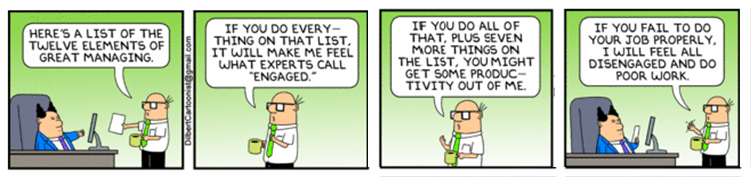
Employee engagement is defined as: ‘employees willingly contributing to the work while putting in intellectual effort, experiencing positive emotions at work and making meaningful connections to others at the workplace [[i]]. A study conducted by Gallup [[ii]] indicates that workplace engagement acts as a powerful catalyst for driving innovation within an organization and improves the business performance of the organization. People need to feel a purpose for what they do and build relationships in order to be entirely happy at work, and therefore more productive and creative. When employees are optimally engaged, they support the vision of the enterprise, put zeal and energy into their work and are most likely to contribute to innovations at workplace.  Higher engagement levels are associated with positive outcomes both at the individual and organizational levels. These outcomes include higher performance levels, lower employee attrition, less absenteeism and raised levels of personal well-being.

Disengaged versus Engaged Employees

There are significant differences in attitude of engaged and disengaged employees towards their work and in the way they view their work company's work practices.
  • Disengaged employees usually redirect opportunities and avoid ownership.
  • They view change as inconvenient and perceive feedback as a threat.
  • They complete tasks merely for compliance and put up excuses when things get difficult.
On the other hand,
  • Engaged employees own opportunities and improve contribution.
  • They look at change as a means for evolution and acknowledge feedback as a mechanism for improvement.
  • They complete task for contribution, and put in efforts when things get difficult.
An optimally engaged workforce results in more ‘fit-performers’ working towards building a more productive, more competitive and more a resilient organization.  However we also need to remember that when engagement is increased to excessively high levels, it might lead to ill-health and burnout of employees.

Drivers for Employee Engagement

The paper 'Creating An Engaged Workforce' indicates that the key factors that drive employee engagement are:
  • meaningful work,
  • clarity of objectives,
  • senior management communication style and vision,
  • person - job fit,
  • person- organization fit
  • line management style,
  • supportive work environment, and
  • employee voice.

In my next post I will discuss more about these drivers and what companies can do to create an 'Engaged Workforce'.


References :

[i] Creating An Engaged Workforce  by Kerstin Alfes, Catherine Truss, Emma C. Soane, Chris Rees and Mark Gatenby, January 2010
[ii] Gallup Study: Engaged Employees Inspire Company Innovation, The Gallup Management Journal, October 12, 2006  

Monday, 16 December 2013

Collaborative Attitude or Individual Brilliance


Source:   www. cutcaster.com
Source: www. cutcaster.com


Collaborative attitude vs. individual brilliance has always been a matter of debate. The subject elicits different responses depending on the socio-cultural context.

Countries like Japan, with team driven culture, have made remarkable progress in technology, thanks to their collaborative attitude. The American system and the European systems have been able to drive innovation with the help of their educational and legal frameworks that allow for collaboration between various people, encourage out of the box thinking and risk taking.

In the Indian society though individual brilliance is highly admired, but team working skills do not receive the desired consideration. That often impedes the output. The advent of electronic gadgets, internet (strangely yes!), increase in nuclear families and increased urbanization have further reduced the social interactions.Nowadays we are seeing that kids increasingly prefer to be confined to their homes playing with gadgets instead of going out to play. In the public transports, people remain glued to their phones, tablets, kindles, etc. rather than talk with their fellow travelers.  The reduction in social interactions may further deteriorate the collaborative skills and team working abilities.

Additionally, the education system plays an important role in shaping up the skills and attitude. The Western education system and some other education systems like the Japanese system focus on building up specific skills and concept learning which fosters a culture of innovation and higher productivity while the education systems in India and in some other Asian countries promote verbatim learning that does not leave much space or freedom for creativity.

The legal system too determines attitude towards work by providing mechanisms for protecting original pieces of work e.g. protection of patents, trademarks, strict laws against plagiarism etc.

If you look at the global business scenario, though some organizations are leaning towards providing work from home facility to their employees to  reduce their cost of operations, but most others believe that productivity increases in an ecosystem that encourages more social interactions between the people.

Apple and Microsoft are designing offices in which people bump into each other more and exchange ideas. Yahoo has banned employees from working from home so that employees work more effectively by having more face to face interactions rather than by using more efficient means like email, phones, etc. Jack Welch, as GE insiders say, would look at the body language and commitment exuded by the manager presenting new ideas rather than look only at the details of the plans.

One of my senior business acquaintances who hails from Korea told me that two things are very important to succeed and drive changes and innovation in an organization – team work and passion. While passion comes from within, people who can work and contribute to a group effort are very important to organizations which in turn have to build up ecosystems to nurture group efforts. He also mentioned that humans who can use their left and right brains equally well are more productive than single brained humans. The left side of the brain is used in structured and analytical work while the right side of the brain is used for instinctive work like arts, sports, etc.

The need for collaboration is further corroborated by an American research finding. In a Scientific American, article  " The limits of intelligence” published in July 2011, Douglas Fox claims that the human brain has reached its limits of intelligence. Now, this sounds counter-intuitive because if the human brain can`t get any better, then how can human output increase in this age of “innovation”.

Fox says that one way is by better social interaction leading to a collective pooling of human brain and the second way is by use of technology (viz. internet).

.

Thus, social interactions facilitated by culture and technology can actually reduce the need for greater individual smart brains!


.
This information based on the research has very important ramifications for organizations, institutions, societies, etc. which are highly influenced by human behaviours.
  • One man army teams, teams with rock stars and high calibre people who can`t gel in a team will have limitations beyond a particular point. As the saying goes – “the whole is better than sum of the parts”.
  • Well rounded personalities would be preferred as compared to uni- dimensional personalities in managerial positions. In an organization a person with high IQ but average – low EQ would be a disaster. Highly left brained or right brained people would find it difficult to contribute to an overall cause beyond a limit.
  • To identify the correct people, organizations would need to have robust recruitment and training processes. People in managerial posts would need to have interests in varied activities like sports, arts, music, etc. to be effective managers.
  • The education system would need to be modified to stress not only on academics but also in extracurricular activities and sports. Rote based systems need certainly to undergo rigorous changes to suit the new challenges in a global system.
  • Women managers would need to be given more positions of responsibility as generally they are better off in team work and more well-rounded and balanced personalities as compared to men.

As my Korean friend said

“Team work” and “Passion” are some of the most important aspects in life.

How true!!
-       Contributed By Ram Narayanan, Sloan Fellow, London Business School

You may also  like to read

Sunday, 8 December 2013

Leadership lessons from the life of Nelson Mandela


Nelson Mandela
Illustration by Manas Maisnam courtesy Kanglaonline.com
As the world pays tribute to the departed great soul, here are some quotes from
Nelson Mandela By Himself: The Authorised Book of Quotations

On life
What counts in life is not the mere fact that we have lived. It is what difference we have made to the lives of others that will determine the significance of the life we lead.

On death
Death is something inevitable. When a man has done what he considers to be his duty to his people and his country, he can rest in peace. I believe I have made that effort and that is, therefore, why I will sleep for the eternity.

On determination
Everyone can rise above their circumstances and achieve success if they are dedicated to and passionate about what they do.

On time 
I never think of the time I have lost. I just carry out a programme because it’s there. It’s mapped out for me.

Leadership Traits of Nelson Mandela

In an article in theguardian, Andrew Rawnsley wonderfully describes the leadership traits of Nelson Mandela that made him one of the greatest leaders of the world.
  • Nelson Mandela had natural charisma, grace, exquisite manners, sense of humour and an air of dignified command around himself.
  • His mission in life was to replace apartheid with democracy. He had the moral courage and clarity of purpose to relentlessly pursue this ideal.
  • He had a powerful sense of destiny, but what made him so very rare was that unlike many other politicians, he did not succumb to megalomania, nor did he elevate himself to the pedestal of a demi-god.
  • He was a rebel, a warrior against the established order. In old age, he liked to remind people that Rolihlahla, his given first name, means troublemaker. There would have been no Mandela, the healer, had he not been preceded by Mandela the fighter.
  • A lesser known aspects of his character is guile. His ideal of a democratic and free society was non-negotiable, yet on most other matters he was flexible, even opportunistic. Being a politician, being a human being, he had his frailties.  He was loyal to a fault to old comrades who were mediocre and corrupt.
  • Mandela did not punish others to affirm their own moral superiority. Mandela affirmed his superiority precisely by forgiving. He won over his enemies with respect, empathy, forgiveness and superhuman magnanimity.
Read the excellent complete article at
Last but not the least, I thank my friend Manas Maisnam for making this beautiful illustration and sharing it.

Friday, 6 December 2013

How to Manage Expectations


Source: www.howit.com


Very few people will dispute the fact that managing expectations is critical to the success of any relationship, be it a business relationship, a professional relationship, or a personal relationship. Managing expectations is all about setting the right expectations, communicating those expectations, and meeting the expectations.
A business that manages to balance the customers’ expectations with its product/service emerges successful. Failure to live up to the expectations of the customers, leaves them disappointed  At the workplace, employees are rated on how often they exceed expectations, meet expectations or fail to meet expectations; as such, at work people need to manage expectations at different levels. These include:

Setting expectations with your manager

How many times have you felt lost when you have been put on a job and nobody told you how to go on about it? If your manager does not give you clear instructions, it is necessary that you yourself approach your manager and ask specific questions that help you to understand what is expected from you. These could be questions on:
  • What is your role on the assignment.
  • Where to seek the resources such as information, training, tools, materials, space, money or people needed to do the assignment.
  • The expected schedule for reporting milestones and meeting interim deadlines.
  • What is the benchmarks for success at the milestone.
  • Guidelines or standards that need to be followed and boundaries that need to be adhered to.

Setting expectations with your clients

Businesses are run on the basis of relationship between a firm and its customers. As such it is very important for a business to know and cater to the expectations of their clients. For that every business needs to:
  • Anticipate the Client’s Needs.
  • Set expectations upfront while cutting down on the unrealistic expectations.  If you over promise and under deliver, people will be disappointed , but if you promise too little, people won’t try your product.
  • Manage expectations through constant communication.

Setting expectations within your team

Your team’s performance reflects your own performance. As such you need set expectations within your team and communicate those expectations clearly to steer your team towards the right direction.
  • Provide Structure, define boundaries.
  • Clarify roles.
  • Provide your team with resources that they need to accomplish their tasks to facilitate their work.
  • Set Motivational goals

Managing your own expectation

Last but not the least managing your own expectation is as important as managing expectations of your clients, your boss, your pears, your family or your friends. Your ability to manage your own expectations will shape your personal brand.
  • Set small achievable, measurable goals
  • Manage expectations of the outcome. Celebrate each small success but don’t let success rule your head or failure rule your heart.
  • Be persistent with your efforts. Step by step move towards the larger target.

Saturday, 25 May 2013

Norms and Stereotypes in Corporate India


India is fast emerging as an innovation base and presents a large market opportunity to companies that are creating economical products and solutions for the country. At the same time, India also has its share of challenges in terms of lack of adequate infrastructure, bureaucratic bottlenecks, complex labor and taxation regulations etc.

But besides these major policy or investment constraints, there are these few other norms & stereotypes typical of the Indian corporate culture, which though are commonplace for most of us living in India, but if changed will work towards projecting a much better image of Indian businesses.

As Indians we are mostly casual about managing time and often tend to take others time for granted. It is not unusual to keep people waiting endlessly for hours together, after fixing up an appointment for a business meeting or for an interview. A person in the top rung of hierarchy will not feel the need to offer the hint of an apology for turning up late, while a person lower in the hierarchy will have a barrage of excuses for running late.

A common practice for businesses is to keep prolonging the payment to vendors, service providers, consultants & and finally not pay up, well knowing that people will refrain from going to courts due to the hassles and delays in the judicial process.

Lack of delegation of responsibilities or passing credit down to the team and lack of proper succession planning are handicaps in most Indian companies.

Gender disparity does persist in our society and permeates the corporate sector as well. In spite of having some highly successful Indian women CEOs, India Inc has had an abysmally low representation of women in senior management positions. Cases of sexual harassment go unreported or are mostly hushed up, particularly when the person in question holds a senior position. Recent sacking of iGate CEO has raised questions about the policies adopted by companies while hiring CEOs with a tarnished behavioral track record.

The need to be perceived as responsible companies with high standards of ethics & corporate governance calls for a change in such practices and norms. Adopting policies and practices to induce a culture of professionalism is a must for Indian companies with aspirations of becoming truly global companies. 

Thursday, 26 January 2012

Planet of the Apes

In the last post, there were comments on organizational inertia. Putting up this comic snippet shared by a  friend that gives an interesting perspective into organizational inertia - how it is difficult to change the prevailing norms, values, beliefs and accepted patterns of  behaviour.                                                                            
                                                                                   
      
More often than not, people who try to change the existing culture are deemed as misfits within an organization and are pulled down by the others. 


     Organizations that have been successful in doing things in a particular way, often tend to stick to the same way of working even after it becomes obsolete, since they are accustomed to it and so they resist changes that might help them to compete better. 

At times it is perceived to be easier to change employees than to change their culture.

-Contributed by Shalini Verma