Tuesday, 15 July 2014

World's Population Distribution - A Few Facts


11th July was the World Population Day. Here are some facts about population Distribution in the World.

Population Distribution in the World

7.2 billion people are estimated to be inhabiting the earth today of which 1.39 billion people are living in China and 1.29 billion in India.

India Population


If all land on Earth were as densely populated as , entire human  could fit in Germany.

Mumbai Density


There are more people living inside this circle than outside of it.

World Population Distribution


Countries with Highest and Lowest Population Growth since 1990.


Japan and Czech Republic are the countries with the lowest population growth since 1990.
Population growth lowest


Countries with the highest population growth since 1990 are not China or India but Qatar and UAE.
Population growth largest

Most Populous Cities in the World

10 Top populous cities in the World in 2014 as reported by the UN are :
  1. Tokyo
  2. Delhi
  3. Mexico City,Mumbai,Sao Paulo
  4. Osaka
  5. Beijing
  6. New York-Newark,Cairo


Thursday, 10 July 2014

Six Charts that show the State of Innovation in India


Economists, academicians for long have recognized the role of innovation in a country’s economic growth. National innovative capacity is defined as the ability of a country – as both a political and economic entity – to produce and commercialize a flow of innovative technology over the long term.

As India takes on its path of economic recovery, the time is apt to look at the state of innovation in India, reflected in its R&D capability. Though the growth of R & D services has been consistently high at around 20 % in the last few years, but India ranks low in its capacity for innovation as compared to developed nations as well as other BRICS nations. In the global gross expenditure on R&D (GERD) of US$ 1.6 trillion for 2014, India’s share is around 3 %, which is around five times lower than that of China.

The Economic Survey Report of India 2013-2014 has highlighted the current state of R&D services in India. A look at the following charts reveals the determinants of India’s innovative capacity and the opportunities for improvement in this area.

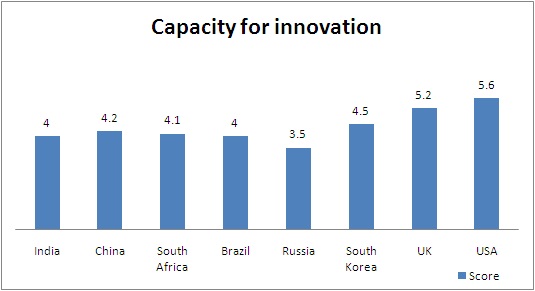
Capacity for innovation

According to the Global Competitiveness Report 2013-14 released by World Economic Forum in Sept 2013, India’s capacity for innovation has been lower than 3 of the other BRICS countries (Brazil, China, and South Africa).
Innovation Capacity
Data: Economic survey 2013-2014

University–industry collaboration on R&D

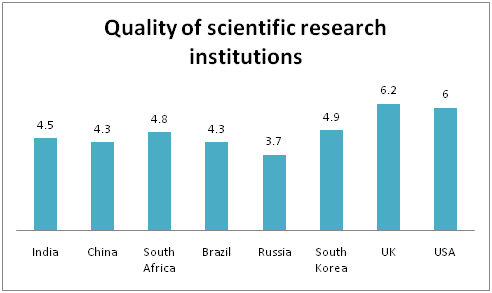
Though India scores better than China, Brazil, and Russia on quality of scientific research institutions, its poor score on university–industry collaboration on R&D as compared to some other BRICS nations like China and South Africa, indicates that research undertaken in such institutions is not percolating down for commercial usage.

Quality of Scientific Institutions
Data: Economic survey 2013-2014


Monday, 7 July 2014

How Corporate Culture Impacts Gender Diversity At Your Workplace


‘The importance of Gender Diversity at workplace' is one of those issues that are often spoken about in conferences, reiterated in survey findings, and yet seldom are a priority unless there is a mandatory obligation for companies to comply with.

With the exception of a handful of countries such as Norway, New Zealand, Iceland, Australia, Switzerland, Netherlands, Canada, Philippines, women are generally under-represented in the corporate sector in a large number of countries all over the world.

Even in the Tech companies that are known to promote employee friendly culture, diversity remains an issue. Google admittedly has a gender gap, so has Facebook. LinkedIn, too would like to improve its gender diversity numbers says the company's Vice President of global talent, Pat Wadors. Twitter was criticized for filing the I.P.O. without a single woman on the board, subsequent to which it appointed Marjorie Scardino as the first woman director to its board.


What impedes gender parity at workplaces?


Among the factors that hinder gender parity at workplaces, ‘Cultural Inertia’ emerges as a predominant reason that holds back the adoption of gender diversity practices.
In Japan, for instance, women have been identified as the most under-utilized resources. A traditionally conservative country, Japan did not encourage its women to remain in full time employment, notwithstanding their high level of education. Faced with the problem of an ageing population and shrinking workforce, Japan is now waking up to the fact that utilization of women talent pool is crucial for the revitalization of its economy. ‘Womenomics’, a term coined by Kathy Matsui in 1999, now forms a vital component of Abenomics, the set of economic reforms advocated by the Prime Minister Shinjo Abe.

India Inc. too has a long way to go for bridging the gender gap at workplace. In India, while entry is easier and a reasonable percentage of entry level positions are filled by women, the percentage of women declines sharply as we move up the ranks. What happens in between the levels is an oft-repeated story.

Click To Continue Reading 

Thursday, 26 June 2014

8 Skills That Will Make You An Effective Leader


'Mostly leaders are born. Some inherit leadership. Some come by default.' These statements coming from an acquaintance on social media induced me to write this post.

When we think of leadership, traits such as charisma, authority, courage, oratory skills easily and instinctively come to our mind. These qualities are associated with great leaders or inspirational figures such as Margaret Thatcher, M. K. Gandhi, Martin Luther King Jr.or Churchill and most these seem to be inborn qualities.

It goes without saying that not all of us can have the style, presence or oratory skills of these great historical figures. Just like some people are gifted singers, while many others struggle to strike the right notes, some people are naturally bestowed with a charismatic persona, while others are not.

Does it mean that in absence of inborn leadership traits, one cannot be a leader? Let us dig into it a bit more. Here I list down 8 key traits of leaders, in an attempt to identify which of these leadership skills can be developed. 

                                       .  .


 1. Clarity of Purpose


A purpose can change a life from ordinary to extraordinary. 

Only an individual with clarity of purpose can inspire, motivate and align people with his vision. This key leadership quality can be attributed to a great extent to the situations that a person is exposed to and how one reacts to them. Some people, albeit a few, find their calling at a young age. However, for most of us, it may take ages to figure out what the purpose in life is and many of us may never find it at all.
This, however, is not a reason to fret about.

In absence of a greater cause or purpose in life, you can still set goals that serve as anchors and devise some philosophy that makes life meaningful.

Click To Continue Reading

Saturday, 21 June 2014

Unique Expressions of Art


Warli Wall Art Festival, 2014.

Wall Art Festival  aims at promoting sustainable international cooperation through the Power of Art. The walls of a primary school in Warli were used as a canvas on which two artists, one from India, the other from Japan, made paintings on the majority of the wall in two separate classrooms.


Sculpture of San Francisco created with toothpicks.


Whimsical, Unique Stone Sculptures by Japanese artist Hirotoshi Ito.


Sunday, 15 June 2014

India’s MIT - Making A Mark In Higher Education


Akin to Darwin’s theory of ‘Survival of the Fittest’, admission into the premier public institutes in India is about 'Survival of the Brightest'. With the scores in board examinations soaring as high as the mercury levels in most parts of the country, both students and their parents feel the heat as competition for admissions into colleges gets tougher.

A score less than 90% is unlikely to fetch a student, a seat in the general category, in a premier public institute. Even so, a score above 90% alone does not suffice for entrance in most of the leading public engineering institutes, where selection is determined by the combined board score and score in the Joint Entrance Examination (JEE).

The tough selection criteria coupled with growing number of applicants each year (over 1.3 million students registered for JEE in 2014) leaves many meritorious students missing the mark to secure a place in the publicly funded institutes. Into this void of demand and supply, have stepped in some private engineering institutes that aim at providing quality education to the students.

Traditionally higher education in India has been the forte of government owned institutions and people have generally been skeptical about the quality of education imparted by the private universities. However the perception seems to be changing. The change somewhat accelerated in this year 2014 itself, after it became common knowledge that the CEOs of two of the world’s most famous technology brands, have graduated from a relatively modest private engineering institute in India.

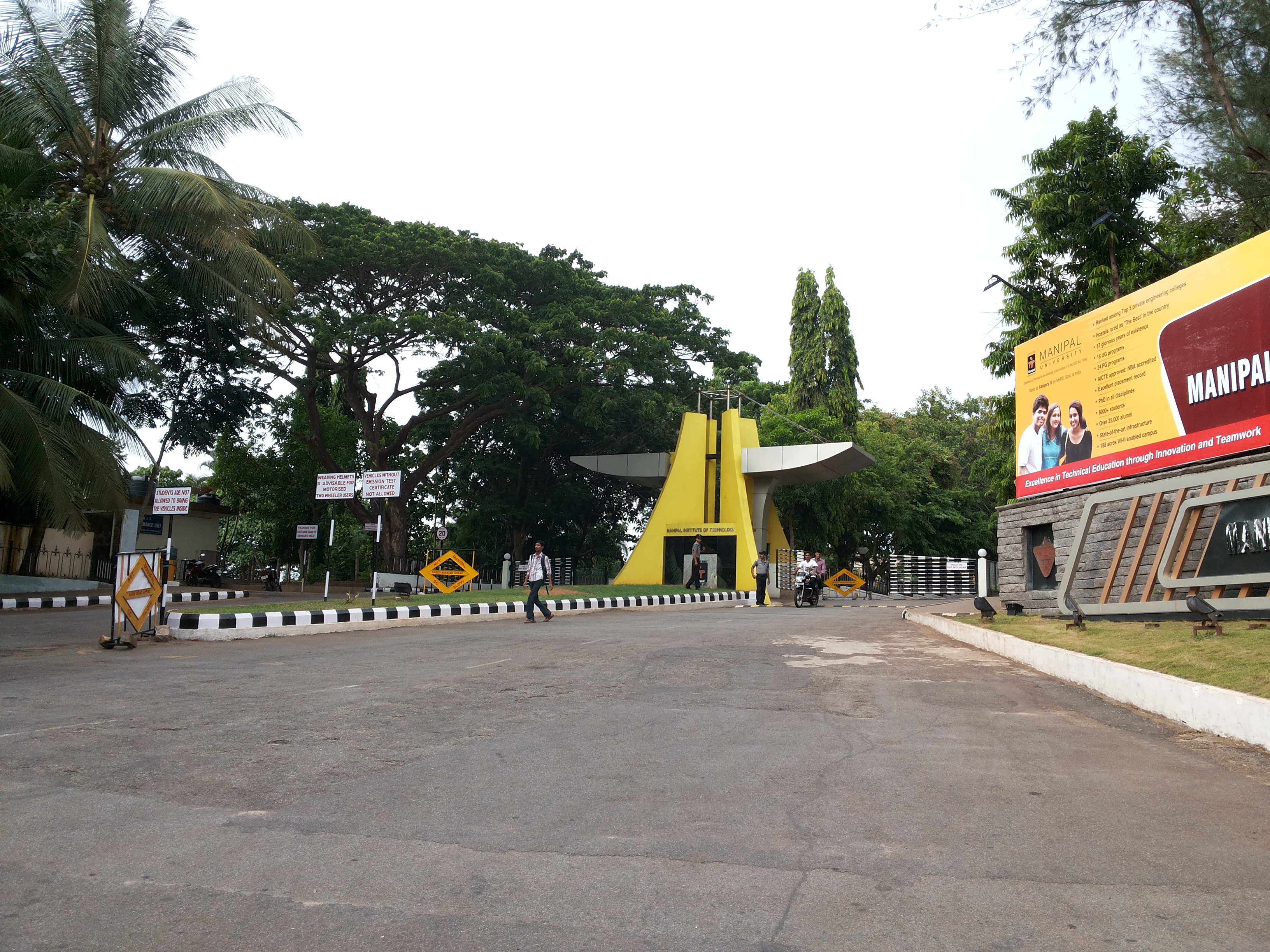
Manipal Institute of Technology (India’s MIT) came into limelight this year as the alma mater of both Satya Nadella, the CEO of Microsoft and Rajeev Suri, the CEO of Nokia.

A visit to the MIT campus last week when I accompanied my daughter for the counseling session for B Tech admission put any remaining doubts to rest.

Located near Udupi in Karnataka, MIT is at a distance of about 60 kms from the Mangalore airport. On the way from the airport to Manipal, the scenic rolling topography, greenery and serenity of the place soothe the eyes and mind.

A large poster at the entrance of the campus with images of the illustrious alumni catches our attention. The MIT campus is a part of Manipal University which is a unique university town by itself. Education drives the economy of the place. The small town with a population of around 35,000 is home to nearly 28,000 students pursuing courses in various disciplines including medicine, engineering, management and humanities.

20140606_17100520140606_170838

Founded in 1957 by Dr TMA Pai, MIT is one of the first self-financing engineering colleges in the country. The campus is spacious, clean, green and self sufficient with Engineering blocks, laboratories, innovation centers, library, separate hostels for girls and boys, a spacious food court, cafeteria, bookshops and small shops for other necessities. Infrastructure is excellent; the campus is Wi-Fi enabled and air-conditioned lecture halls are equipped with hanging projectors. About half a km away from the campus is Marena, a large the indoor sports arena that provides world class sports facility to the students and staff of Manipal University.

Counseling sessions are transparent and well organized. Real time status update on allotment of seats show on big screens in the lecture halls where the counseling sessions are conducted. The status is made available on the college website at the end of each session. No one seems to be in a rush and yet everything gets done efficiently and on time.

Dr Murthy, a senior professor at MIT is kind enough to guide us around the campus. We meet Director Dr Vinod Thomas and Joint Director Dr Srikanth, who come across as warm and very down to earth people. The professors, head of departments have mostly graduated from the IITs or NITs. They appear genuinely interested in getting to know the new students as well as their parents. I find it reassuring to know that children of many of the professors are studying in the institute; it speaks volumes about the amount of confidence they have in their institute. The placement statistics too are good with close to 80% students getting placed in companies recruiting from the campus. Above all, the place seems safe for girls, which addresses a big concern for most parents.

Hopefully the coming years will see more such smart universities emerging in the private sector to cater to the growing demand for higher education in India. Engineering and management institutes such as Nirma University of Science and Technology, Vellore Institute of Technology, Dhirubhai Ambani Institute of Information and Communication Technology, ISB and Symbiosis are already making their mark.

Monday, 9 June 2014

Two Interesting Historical Facts


I came across these two articles with historical facts presumably unknown to many, as they were to me, so found them worth sharing.
As a whole lot of information is shared on Twitter, I am adding this section 'TweetBits' (on the Menu) to include some of the informative and interesting tweets. Retweet is possible from the included tweet itself.

Britain has invaded all countries in the world barring 22 countries at different points in time.


Contrary to the common belief that the British rule extended to a quarter of the atlas, a study indicates that barring 22 countries in the world, all other countries have experienced an invasion by the British at different points in time.
Among the select group of nations that have never been invaded by Britain are countries such as Guatemala in Central America, Bolivia, Paraguay in South America, Mali, Chad, Congo in Africa, Monaco, Vatican City, Luxembourg, Sweden in Europe, Tajikistan, Uzbekistan, Krygyzstan and Mongolia in Central Asia .
The analysis is contained in a new book, All the Countries We’ve Ever Invaded: And the Few We Never Got Round To , written by Stuart Laycock. The complete article is available on http://goo.gl/gVS2Rm.

World War 1 propaganda maps in pictures


The use of caricatures and cartoons in World War 1 propaganda maps show how cartography can be turned into a rhetoric of war.
In this map, Great Britain, personified as a muscular John Bull, is shown striding across the English Channel to to take charge of Europe in a colourful map of first world war propaganda. The map was published in London at the outbreak of the war, and was intended to show confidence that Germany and its ally Austro-Hungarian empire would be defeated swiftly by the combined might of Russia, France and the British empire.
The complete article can be found on http://goo.gl/d781U1.


References:
http://worldobserveronline.com/2012/11/09/british-invaded-nine-ten-countries-look-luxembourg/
http://www.theguardian.com/books/gallery/2014/jun/03/war-ww1-propaganda-maps-in-pictures