Friday, 24 January 2014

Engaging employees for creating business value


What prompted me to write this post was a discussion on a Linked In group about the role of a ‘Chief Inspiration Officer’ in an organization in inspiring employees and creating an engaged workforce.  The fancy title caught my attention and I followed through the discussion. As always, the discussion had people with different viewpoints. While some thought that this is absolutely the 'wave' of the future, others were not very optimistic about the prospect for such a title. However the objective of writing this post is not to elaborate on the role of ‘Chief Inspiration Officer’.
I will instead talk about the need for employee engagement at work.  It is a well accepted and often reiterated statement that  for any business to be successful, it should be able to successfully execute  its business strategy, not only once, but over and over again. To be competitive in the long run, every business needs to repeatedly do something that appeals to its customers. It also needs to possess some unique resources that continue to give the business an edge over its competitors. Such competencies and resources that are valuable, rare and inimitable render a  sustained competitive advantage to an organization.
Though most organizations claim that their people are the source of their competitive advantage, but we know for a fact that only a few organizations succeed in effectively leveraging the intellectual capital and unique abilities of their employees to achieve extraordinary results. Creating and delivering value on a sustainable basis,  calls for the presence of engaged workforce in an organization.

Engaging your Employees

What does 'Employee Engagement' mean?

Employee engagement is defined as: ‘employees willingly contributing to the work while putting in intellectual effort, experiencing positive emotions at work and making meaningful connections to others at the workplace [[i]]. A study conducted by Gallup [[ii]] indicates that workplace engagement acts as a powerful catalyst for driving innovation within an organization and improves the business performance of the organization. People need to feel a purpose for what they do and build relationships in order to be entirely happy at work, and therefore more productive and creative. When employees are optimally engaged, they support the vision of the enterprise, put zeal and energy into their work and are most likely to contribute to innovations at workplace.  Higher engagement levels are associated with positive outcomes both at the individual and organizational levels. These outcomes include higher performance levels, lower employee attrition, less absenteeism and raised levels of personal well-being.

Disengaged versus Engaged Employees

There are significant differences in attitude of engaged and disengaged employees towards their work and in the way they view their work company's work practices.
  • Disengaged employees usually redirect opportunities and avoid ownership.
  • They view change as inconvenient and perceive feedback as a threat.
  • They complete tasks merely for compliance and put up excuses when things get difficult.
On the other hand,
  • Engaged employees own opportunities and improve contribution.
  • They look at change as a means for evolution and acknowledge feedback as a mechanism for improvement.
  • They complete task for contribution, and put in efforts when things get difficult.
An optimally engaged workforce results in more ‘fit-performers’ working towards building a more productive, more competitive and more a resilient organization.  However we also need to remember that when engagement is increased to excessively high levels, it might lead to ill-health and burnout of employees.

Drivers for Employee Engagement

The paper 'Creating An Engaged Workforce' indicates that the key factors that drive employee engagement are:
  • meaningful work,
  • clarity of objectives,
  • senior management communication style and vision,
  • person - job fit,
  • person- organization fit
  • line management style,
  • supportive work environment, and
  • employee voice.

In my next post I will discuss more about these drivers and what companies can do to create an 'Engaged Workforce'.


References :

[i] Creating An Engaged Workforce  by Kerstin Alfes, Catherine Truss, Emma C. Soane, Chris Rees and Mark Gatenby, January 2010
[ii] Gallup Study: Engaged Employees Inspire Company Innovation, The Gallup Management Journal, October 12, 2006  

Sunday, 12 January 2014

The Aam Aadmi Party`s governance agenda - will it succeed?


The “Aam Aadmi Party (AAP)” revolution in India led by Arvind Kejriwal has caught the attention of the entire country so much so that the onetime poster boy of the media – Narendra Modi- has been swept off the media pedestal. As per the AAP spokesperson Yogendra Yadav, people have voted for AAP for 3 reasons viz. clean politics, good governance and anti- corruption. Very true!


AAP


Narendra Modi's agenda has included these two themes along with economic development as a part of his election campaign. Arvind Kejriwal is being touted as the 3rd alternative for the Prime Minister's post so much that a national newspaper has reported today that Modi has pressed the panic button fearing the AAP wave.
What does the country need now? Given the precarious economic scenario that we find ourselves in, economic development is very important for our country. Our GDP growth rate has fallen to sub – 5% levels from the 9% levels we were in a few years back. However, the country has been severely shaken by the numerous corruption scandals in the last few years and historically corruption has been rampant in this country ever since our independence. Hence governance and anti –corruption plank have also become equally extremely important and has caught the imagination of the people especially the middle and upper class that are fed up with the 2 big national parties.
A research paper “Is good governance good for development[1]?” argues that good governance is not a necessary precondition for development. The research paper lists some obstacles mainly the different political characters of various nations. The western nations saw a surge in their economic development in the 18th and 19th centuries when the term governance was unheard of. In the last few decades we have seen the rise of China and some other East Asian countries that would rank not very high on the governance matrices.
So what is important now-
  • Governance or economic development?
  • Is governance required for economic development?
My answer would be yes. Good governance is a good supporting factor for sustainable economic development and possibly to convert economic miracles to sustainable development. The presence of proper institutions like judiciary, legislature and executive machinery is important to deliver the benefit to the people and avoid issues like corruption, inefficient allocation of resources, etc. A well-developed banking and financial system can lead to financial inclusion. Speeding up of judicial activities can ensure protection of ordinary citizens and protection of industrial interests.
For a sustainable and balanced growth of the country it is therefore necessary that economic development goes hand in hand with good governance. Given the size and political status of India, it is imperative that we have do not have a governance less development like the Middle East and some African nations and neither should governance impede development as still a sizeable population is below the poverty level. Singapore can be quoted as a good example of a “proper” balance of governance and development. While many critics can describe Singapore as prison state, the government under the tutelage of the previous premier Lew Kuan Yuew has developed Singapore to be a model of economic prosperity and a toast of the world. People are willing to let go some freedom for economic prosperity.
The Delhi AAP government of Arvind Kejriwal has taken 2 sets of decisions since taking power in late December`13 viz. governance decisions like anti-corruption telephone line and audit of power discoms and on the other hand populist measures like power subsidy and free water. The populist measures smack of “Leftist” thinking which has long been rejected by people. In fact the communist parties are being threatened with the advent of AAP!
Hence Arvind Kejriwal and his AAP team members should probably work on the following paths:
  1. The focus on governance is what the country needs and people would love to see the same being institutionalized. Hence the AAP should implement measures and systems to make governance a way of life. Some of them would be institutionalizing the Lokpal bill, ensure proper law and order, regular availability of metered and billed power and water, improve efficiency of government services and last but not the least infrastructure. This in turn would help the economy as well. This will not happen overnight but a proper process can be put in place to do this. One way, which has been initiated, is to form teams with professionals (true aam aadmis!).
  2. AAP should not be seen as anti- business and hence should avoid socialist  leanings like the Congress. An anti- business stance will hit the economic  development and can prove counterproductive.
  3. Populist measures, especially subsidies need to be avoided as these are  truly anti proper governance.
To conclude, I would sincerely hope that the Aam Aadmi Party truly becomes a mainstream political party and cleans up the entire Indian system and in the process ensure an all-round development of India. All the best AAP !!

[1] Kwame Sundurama, Jwame and Choudhry.  United Nations Series on Development.

-       Contributed By Ram Narayanan, Sloan Fellow, London Business School


Adding on to Ram's article, I would like to say:

As much I admire Aam Aadmi Party ( #AAP 's) anti-corruption stance and their ideology of including opinion of the common people in the governance, I hope that they do not create or set expectations that might be difficult to sustain in the long run without compromising on the country's growth prospects. Rather than going overboard on populist measures such as entitlement and subsidies, taking a balanced / calibrated approach will augur well for the overall economic development of India.

-   Somali Chakrabarti, Sloan Fellow, London Business School

Monday, 6 January 2014

CAG audit of private telecom companies - Governance or Interference?


CAG auditIn a verdict yesterday, the Delhi High Court allowed the Comptroller and Auditor General (CAG) of India to audit the accounts of private telecom companies under the Telecom Regulatory Authority of India (TRAI) Act.

This his kind of ruling was unthinkable even a few years back as CAG was and is still largely seen as an auditor of companies owned by the government.

As natural resources such as spectrum, gas/oil fields, coal, etc cannot be easily priced,  the government has a big stake in these sectors and many of these companies that are involved in the production sharing of natural resources or profit sharing from natural resources  enter into a public-private partnership (PPP) with the Government of India, so it appears logical that industries and sectors that deal with precious natural resources come under the ambit of CAG.

CAG doing audit of such private companies will have the several ramifications on the overall dynamics of the industry.
  1. It will expand the role of the institution and may influence the auditing methods followed in companies. CAG will aim to check if there are any efforts to pad up costs or any instances of loss of revenue to the government where the private players have enjoyed profits that ought to have gone to the government. Their audit report will be as valuable for the investors as the external auditor's report. There might also be some conflict with the Income Tax Department if CAG checks the accounts and find cases of discrepancies in the tax payments.
  2. Though the audit is to pertain to the audit of receipts, but to do a fair audit CAG may demand access to information such as top-level deliberations and decisions or the minutes books of the board of directors.  While the CAG may see this as governance, companies may construe it as excess of interference. CAG may form an opinion depending on the information that it comes across during audit and ask companies to provide suitable justification for any expenses that they might have incurred but not shown in the books. According to the Principle of Materiality companies only need to include significant or material expenses in the accounting statements. Non material expenses that are either small or are not significant are not included in the books of accounts.
    Any unresolved difference of opinion between CAG and companies on materiality of accounts could negatively impact the companies. Theoretically a company should not run into difficulty if a reasonable return is guaranteed vide the framework. But if any inefficiencies are highlighted , then it could result in fine being levied, and which may impact the bottom line of the companies and may result in deterioration in the quality of services being provided as the company runs into difficulties.
  3. Many decisions could come under the scanner including those involving procuring spectrum at low prices and selling them to foreign players at windfall gains , thus shifting the gains from government to private players and other revenue sharing details.  It could also lead to CAG fixing accountability by inferring omission and commission if they do not get information to their satisfaction.
  4. In any public company it is the responsibility of the Board of Directors to select and approve the auditors  to ensure fair audit and share the findings of the audit with the stock holders and financiers. With CAG conducting a separate audit, there is a possibility of some change in the power equation of the Board.
This ruling also shows that changes do start taking place albeit gradually when there is an erosion of confidence in the system or in certain institutions.

What do you think? Do share your views. 

Wednesday, 1 January 2014

Ten inspiring thoughts to begin 2014 with


HNY20142
.
" Talk to yourself once in a day. Otherwise you may miss an excellent person in this world."  -  Swami Vivekananda.

"Learn from yesterday. Live for today. Hope for tomorrow." - Albert Einstein

"Strength does not come from physical capacity. It comes from an indomitable will." -  Mohandas K Gandhi

"I think setting a goal, getting a visual image of what it is you want. You've got to see what it is you want to achieve before you can pursue it." – Chuck Norris

"Ups and downs in life are very important to keep us going, because a straight line even in a ECG means that we are not alive." – Ratan Tata

"Though no one can go back and make a brand new start, anyone can start from now and make a brand new ending." - Carl Bard

"Appreciation can make a day, it can even change a life." - Margaret Cousins

What good is wealth without health?

It is better to travel well than to arrive.

Sometimes in the winds of change we find our direction…..

Saturday, 28 December 2013

Salary Comparison for Project Management Professionals in 2013


The median salary of Project Management Professionals has been found to vary with a number of key demographic factors, as per a '2013 Salary Survey' report published by Project Management Institute, PMI, US.  These include factors such as:
  • Country of employment
  • Number of years experience in project management
  • Position/Role
  • Average size of projects managed, including average project budget and average project team size
We present the comparison of salary information for 10 countries from the PMI report.

Country of Employment

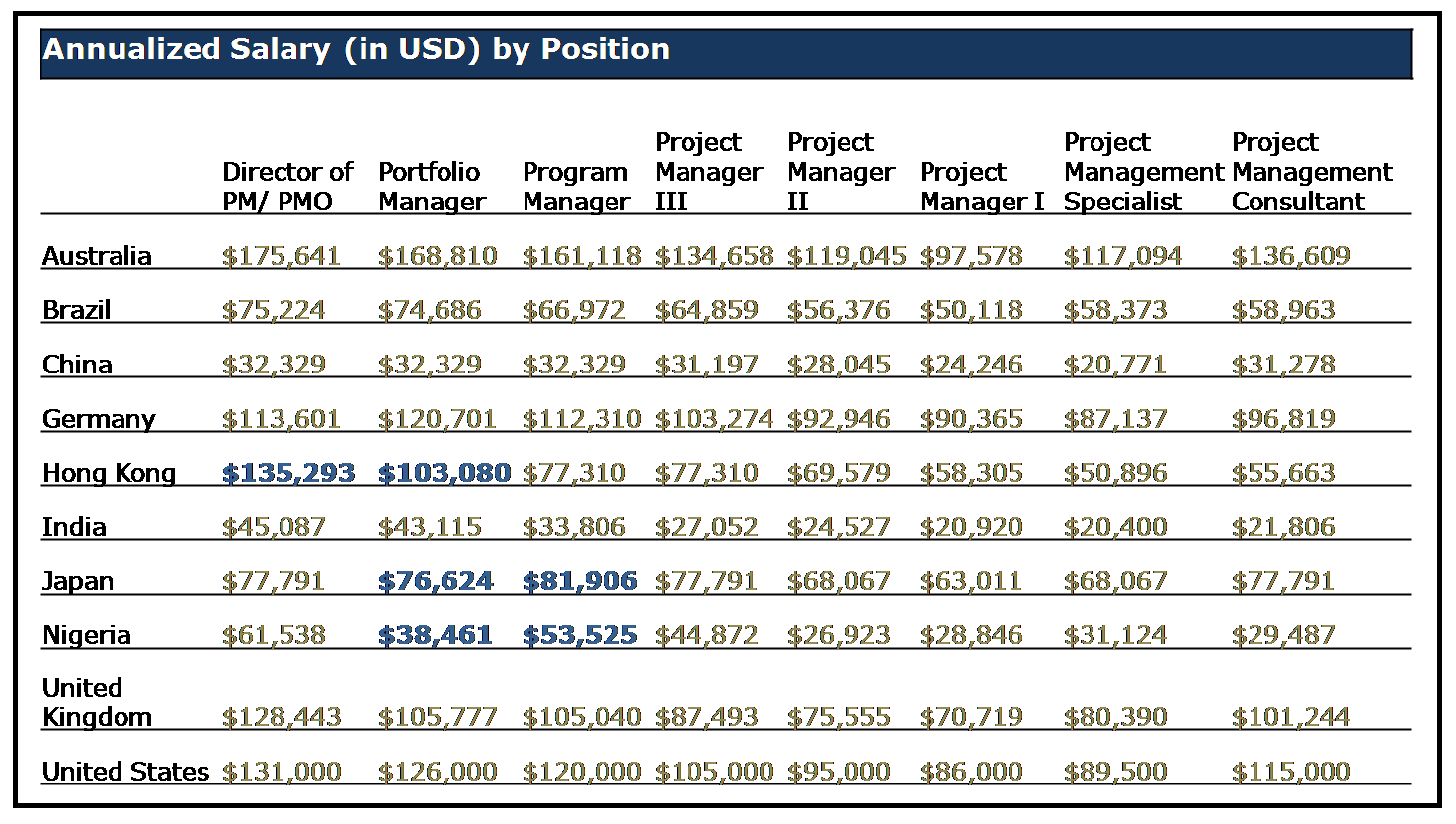
The median salary for project management professionals vary widely from country to country.  The country with the highest median salary ($134,658 USD) is Australia, whereas India and China are amongst the countries with the lower range of median salary (around $27,000 USD).

Country


Position

Within the various levels of project managers, salary appears to increase with added responsibility as a person proceeds from being a Project Manager, to a Program Manager, to Portfolio Manager, to the Director of a Project Management Office. There are some exceptions to this order though. In Germany the salary of Director of PMO is less than the salary of Portfolio Manager. The differential salary increase between different levels appears to be low in Japan, China and India.


Position


.


Number of Years Experience in Project Management

The number of years a person has worked within the project management profession has a direct positive correlation with the salary. Again the difference in median salary varies by country.  A dramatic increase is seen in Nigeria.  The median salary ranges from $19,231 (USD) for those just starting out in the project management field to $61,538 (USD) for those who have been in the field for 10 -15 years.  This represents an increase of nearly 230% from low-to-high experience in the field.  The difference in median salary is not as striking in China.
Experience


.

Project Size (Average No of Team Members and Project Budget)

The size of projects managed, in terms of average number of team members and average project budget, also appears to have a positive correlation with annual salary.
In Nigeria, those managing projects with budgets of $10 million or more earn 96% more than those with projects under $100,000. In Japan and India the figure is around 50% more. In Japan, China and India those managing projects with larger teams (20 or more people) have a median salary that is 30 - 34% higher than those managing teams of 1 to 4 people.
TeamMem


Budget


Thursday, 19 December 2013

Beginning of Fed Taper - Impact on India and other Emerging Markets


Two major events scheduled on the 18th of December, were seen as deciding factors for the stock market movement in India by the end of 2013.

First was the announcement of monetary policy by the Reserve Bank of India (RBI) governor. Raghuram Rajan beat the market expectations of a hike in interest rates and surprised the markets pleasantly with no changes to the current monetary policy. RBI kept the repo rate unchanged at 7.75 % , the reverse repo at 6.75%, the cash reserve ratio at 4% and the marginal standing facility and the bank rate at 8.75%. Markets reacted favorably to the announcement.

taper


Later on the same day, US Federal Reserve Chairman Ben Bernanke initiated pullback from Quantitative Easing (QE) before the end of his term in 2014 with Janet Yellen taking over as the Chairperson of Federal Reserve. The size of the taper, $10 bn was in line with what the market had expected back in September, 2013. The announcement saw the US markets shooting up. DJIA closed up by more than 1.84%, Nasdaq by 1.15%, S&P  500 by  1.68 % respectively. The day after, Asian markets reacted to the taper with Japan's Nikkei rallying while Hong Kong, Shanghai and Indian markets swinging between gains and losses. The European stocks rallied to US Fed taper.

In the Federal Open Market Committee (FOMC) quarterly meet held on 19th June, 2013, Fed Chairman Ben Bernanke had first given an indication about the potential reduction in Fed’s bond buying program, subject to improvement in the US economy. Some of the indicators of economic recovery considered were unemployment target (at 7 percent), targeted inflation rate (at 2 percent) and economic growth (between 2.3 - 2.6 percent) for 2013. The announcement had sent jitters in the world markets and laid bare the tremendous impact that decisions about the US monetary policy, have on markets all over the world.

The Federal Reserve had adopted an expansive monetary policy, since 2009, with the objective to spur economic growth in the US. After the financial crisis of 2008, Fed had rolled out new emergency lending programs to bail out the banks and had lowered the federal funds interest rate from 2 % to a range between 0 and 0.25 %. When the interest rates could not be further lowered, Fed started the first round of QE in March 2009 to help revitalize mortgage lending and support the housing market by increasing the availability of credit in private markets.

The second round of QE by Fed, began in November 2010, to strengthen the economic recovery and protect the economy from falling into deflation. In September 2011, Fed stepped up its purchases of Mortgage Backed Securities (MBS) and on September 13, 2012, the Fed announced QE3, thus adding a total $85 billion of liquidity a month.

The rise in liquidity in the US market due to Quantitative Easing saw money flowing into Emerging markets as US investors invested in these stock markets in search for higher returns. Inflows from Foreign institutional investors (FIIs) in Indian markets stood at $24.54 billion in 2012. In 2013, FIIs have infused around $18.7 billion into Indian equities so far in 2013.

Uneasiness crept into the world markets in June 2013, after Ben Bernanke hinted of starting a gradual withdrawal of QE by the end of the year if the economic data supported the story of improvement in the US economy. The investors, having gotten used to the excess liquidity, became very concerned about the end of Federal Reserve's accomodative policy stance and thus stock markets started exhibiting higher volatility in anticipation of start of taper.

Throughout the year Ben Bernanke was seen managing the expectations of the markets and investors, and giving assurances to start reducing its bond-buying program in a manner that would cause minimal disruption to the markets. In their previous policy meet in September, 2013 FOMC surprised the markets by delaying the taper when the market was almost prepared for it. As a result most markets were exuberant and picked up the upward momentum again. FIIs resumed buying into the Indian markets in September.

In its last policy meet for 2013 on 18th December, FOMC surprised yet again, albeit partially, as they chose to go ahead with the taper when only a minority was expecting it. Fed stated that the decision to reduce its monthly bond purchases by $10 billion was taken in light of:
  • Improvement in the US job market.
  • Easing of Fiscal restraint.
  • Expected increase in inflation up to 2%.
As a counterweight to try to avoid a very bearish market reaction, the FOMC maintained a dovish forward guidance and said that they to expect to keep the funds rate at zero until well past the unemployment hits 6.5 percent.The first rate hike is not likely to happen until 2015, according to the projections released by the FOMC.

Under the leadership of Yellen, if Fed continues to pull back on it stimulus, the markets may begin to perform more in line with economic fundamentals and the returns could diminish. The impact might be felt worldwide as the US investors investing in other countries may take money out of those markets to invest in the US. Besides, the fact that the US dollar plays a crucial role in international markets, makes the markets extremely sensitive to any policy that impacts the dollar. The effect of outflow could be pronounced in the emerging nations which depend on dollar inflows to finance their current account deficits. The currencies of the Emerging Markets, may face risk of further depreciation if large outflows take place from these countries.

With the currency stabilizing and the improvement in the current account deficit (CAD) , we hope that impact on the Indian market remains muted in the year 2014.


Monday, 16 December 2013

Collaborative Attitude or Individual Brilliance


Source:   www. cutcaster.com
Source: www. cutcaster.com


Collaborative attitude vs. individual brilliance has always been a matter of debate. The subject elicits different responses depending on the socio-cultural context.

Countries like Japan, with team driven culture, have made remarkable progress in technology, thanks to their collaborative attitude. The American system and the European systems have been able to drive innovation with the help of their educational and legal frameworks that allow for collaboration between various people, encourage out of the box thinking and risk taking.

In the Indian society though individual brilliance is highly admired, but team working skills do not receive the desired consideration. That often impedes the output. The advent of electronic gadgets, internet (strangely yes!), increase in nuclear families and increased urbanization have further reduced the social interactions.Nowadays we are seeing that kids increasingly prefer to be confined to their homes playing with gadgets instead of going out to play. In the public transports, people remain glued to their phones, tablets, kindles, etc. rather than talk with their fellow travelers.  The reduction in social interactions may further deteriorate the collaborative skills and team working abilities.

Additionally, the education system plays an important role in shaping up the skills and attitude. The Western education system and some other education systems like the Japanese system focus on building up specific skills and concept learning which fosters a culture of innovation and higher productivity while the education systems in India and in some other Asian countries promote verbatim learning that does not leave much space or freedom for creativity.

The legal system too determines attitude towards work by providing mechanisms for protecting original pieces of work e.g. protection of patents, trademarks, strict laws against plagiarism etc.

If you look at the global business scenario, though some organizations are leaning towards providing work from home facility to their employees to  reduce their cost of operations, but most others believe that productivity increases in an ecosystem that encourages more social interactions between the people.

Apple and Microsoft are designing offices in which people bump into each other more and exchange ideas. Yahoo has banned employees from working from home so that employees work more effectively by having more face to face interactions rather than by using more efficient means like email, phones, etc. Jack Welch, as GE insiders say, would look at the body language and commitment exuded by the manager presenting new ideas rather than look only at the details of the plans.

One of my senior business acquaintances who hails from Korea told me that two things are very important to succeed and drive changes and innovation in an organization – team work and passion. While passion comes from within, people who can work and contribute to a group effort are very important to organizations which in turn have to build up ecosystems to nurture group efforts. He also mentioned that humans who can use their left and right brains equally well are more productive than single brained humans. The left side of the brain is used in structured and analytical work while the right side of the brain is used for instinctive work like arts, sports, etc.

The need for collaboration is further corroborated by an American research finding. In a Scientific American, article  " The limits of intelligence” published in July 2011, Douglas Fox claims that the human brain has reached its limits of intelligence. Now, this sounds counter-intuitive because if the human brain can`t get any better, then how can human output increase in this age of “innovation”.

Fox says that one way is by better social interaction leading to a collective pooling of human brain and the second way is by use of technology (viz. internet).

.

Thus, social interactions facilitated by culture and technology can actually reduce the need for greater individual smart brains!


.
This information based on the research has very important ramifications for organizations, institutions, societies, etc. which are highly influenced by human behaviours.
  • One man army teams, teams with rock stars and high calibre people who can`t gel in a team will have limitations beyond a particular point. As the saying goes – “the whole is better than sum of the parts”.
  • Well rounded personalities would be preferred as compared to uni- dimensional personalities in managerial positions. In an organization a person with high IQ but average – low EQ would be a disaster. Highly left brained or right brained people would find it difficult to contribute to an overall cause beyond a limit.
  • To identify the correct people, organizations would need to have robust recruitment and training processes. People in managerial posts would need to have interests in varied activities like sports, arts, music, etc. to be effective managers.
  • The education system would need to be modified to stress not only on academics but also in extracurricular activities and sports. Rote based systems need certainly to undergo rigorous changes to suit the new challenges in a global system.
  • Women managers would need to be given more positions of responsibility as generally they are better off in team work and more well-rounded and balanced personalities as compared to men.

As my Korean friend said

“Team work” and “Passion” are some of the most important aspects in life.

How true!!
-       Contributed By Ram Narayanan, Sloan Fellow, London Business School

You may also  like to read