Monday, 24 March 2014

Corporate Social Responsibility in India - Transition from Moral Imperative to Mandatory Expenditure


Mandatory spending on Corporate Social Responsibility is the new reality for Corporate India. The enforcement of this provision from April1, 2014, has shifted focus from the debate on whether CSR is a moral imperative or not to how companies can put the mandatory CSR expenditure to effective use.

The provision of the Companies Act 2013, mandates that any company with a net worth of at least Rs 500 crore or a turnover of Rs 1,000 crore or a net profit of at least Rs 5 crore would have to spend at least 2 per cent of its average net profit of the immediately preceding three years. According to the norms, the CSR activities will have to be within India wherein companies can choose from a range of activities such as promoting preventive health care and sanitation, setting up homes and hostels for women and orphans and livelihood enhancement projects. If a company is unable to spend the amount, an explanation will be required in the director’s report.
.
CSR_Lead Essay.indd

As a result of this provision, many corporate enterprises are stepping up their CSR efforts. However the fact is that many companies still lack the processes to channelize the allocation of these funds. For instance, in its report on CSR activities of Coal India, the parliamentary panel on coal and steel mentions that  “Of the allotment of Rs 553.33 crore in 2011-12, Coal India and its subsidiaries could spend only Rs 82 crore (14.8 per cent). Coal India sources said the failure to meet the target was more on account of procedural delays rather than lack of funds and initiative on its part.

Corporate entities will now have to reorient their CSR spending under the provisions of the Companies Act 2013.and set up processes and mechanisms to ensure that CSR funds are directed to productive uses and prevent unethical and inappropriate funneling of CSR funds for private purposes.
Additionally companies will need to expend management time and resources to set up processes for:
  • Creating transparency and accountability in the utilization of CSR funds.
  • Identifying CSR initiatives that are synergistic with company strategy.
  • Conducting due diligence for effective utilization of funds in creating value for society. For example when the funds are earmarked for towards projects for creating some new facility (say a medical center) it makes sense to check if there are pre existing facilities in the area that can be augmented effectively instead of creating new facilities.
  • Gathering knowledge of similar/ duplicate initiatives that other companies might be launching concurrently.
  • Collaborating with other organizations that can effectively utilize CSR funds for socially relevant purposes.

Industry bodies can help in the coordination of CSR activities by sharing information about CSR initiatives shepherded by different NGOs or companies. This could also lead to setting up of social enterprises with expertise to undertake CSR initiatives for companies or funds fund to pool CSR resources for a fee and make sure the corpus is spent intelligently.
 Undoubtedly, CSR gaining traction in the corporate sector is a step forwards towards corporate participation to bring about inclusive growth and sustainable development to aid India’s transition from a developing to a developed nation.


References:

Saturday, 8 March 2014

Moving Towards a Responsible India


India has, for long, been an emerging economy. While most of the developed economies including the US, consider India as a strong prospect, the large and widening performance-potential gap in India leaves a lot to be desired.

A question that frequently pops up in a number of forums is ‘What can bring about the transition of India from a emerging to a developed nation?’

The importance of an environment that supports development, enforces law and order, promotes entrepreneurship and steers the country towards higher productivity cannot be stressed enough in this context. Most people would agree upon the need to do away with red tape, corruption and have policies in place to prop up the economic development and growth. Yet, in addition to the changes in the business environment, certain behavioral, cultural and value related changes are also needed in our society, to aid India’s transition to a developed nation. Unfortunately many of these softer aspects have been severely under rated by our society in the recent past.

As the saying goes ‘No nation can rise above the quality of its thoughts'.

Progressive thinking is needed, if we have to evolve as a developed nation. To build a nation that makes the world sit up and notice, we need imaginative, inventive, responsible and determined people. We need motivated and responsible citizens who can bring about the changes in an inclusive and sustainable manner.

Systematic efforts to help people develop a broad outlook and inculcate a sense of responsibility towards the society can help to bring about India’s transformation to a developed nation in the truest sense. The basic DNA of our society must be molded to shape up a world class mindset.

We are yet to realize Rabindra Nath Tagore’s dream of the nation: ‘Where the mind is without fear and the head is held high’.

At this point, I would like to highlight 3 key issues that widely prevail in our society, impact our lives, impede development and that are likely to concern almost all thoughtful Indian citizens.

1.     Safety of women and children:

Sexual assault - casual or otherwise - is a burning social problem in India that has been brought into focus following a number of brutal rapes that became notorious worldwide. The show Satyamev Jayate’s first episode fight against rape #FightingRape [[i] ] brought out the uncomfortable realities about the issue of rape in the country. Notwithstanding the widespread media coverage of the issue, the number of rapes and sexual assaults are increasing by the day. The frequent incidents of sexual assaults against Indian women and against foreigner women travelers to India severely tarnish the image of the country.[[ii] ] and present a regressive picture of India to the world.

To reduce the occurrence of such crimes strict laws and better enforcement of the laws are needed; but as a society too, we must take this issue a lot more seriously. As the father of a victim said ‘women in India won't be safe until society changes its attitudes’.

A step towards changing the attitude is the need for creating awareness by training women, children and men to recognize the danger signals, take adequate precautions to safeguard themselves against violence and assault. Continuous reinforcement of the need to respect women, demonstrate responsible behavior, protect the safety of women and children and be sensitive to the survivors of sexual assault can be a step forward towards making the country a safe place for children and women.

2.     Traffic collisions and Road Traffic accidents

The frequency of traffic collisions in India is highest, globally. In India, nearly 80,000 people get killed and 340,000 are injured every year in about 300,000 accidents on the road network of 22, 00,000 km — there is an accident every minute and death every eight minutes.[[iii]] The impact of Road Traffic accidents has been found to be most striking on the young, between the ages of 15 and 29 years.

This undeniably this calls for accident-prevention programs, extra supervision by traffic police, well lit roads, zebra crossings, but there is also a need to change the belief that accidents are, ‘accidental’ and not ‘preventable’ .[[iv] ]

The most common reference to injurious events, ‘accidents,’ evokes a feeling of chance, misfortune, and helplessness. We need a shift in focus from inevitability of the accidents to preventability of accidents and injury control. [[v]]

3.     Lack of cultural sensitivity

 The unfortunate death of the 19-year-old Nido Taniam in Delhi last month triggered massive public protests and sparked a debate on discrimination against Indians from the North East. It also brought out the cultural biases and elements of racism that are deeply ingrained in our psyche and occasionally manifest in form of horrific actions.
This draws attention for the need of conscious effort to promote cultural tolerance among each and every citizen in the country. It's time we examined our own attitudes towards people from different parts of the country, other ethnicities or races.
All the above mentioned issues stress the need for an inclusive and scalable approach to deal with these challenges and create awareness about:
  • Safety of women and children
  • Safety on roads – preventing road  injuries
  • Cultural sensitivity
Taking cues from the success of the ‘Teach India’ movement, an initiative can be started with an objective to develop more responsible citizens of the country.
Like ‘Teach India’, ‘Responsible India’ initiative can be a CSR initiative undertaken by a Corporate / Media group, with activities coordinated by a NGO.

Responsible India
Responsible India

Housing societies, education institutes, corporates can register on website and nominate volunteers who would get trained and deliver the programs in their respective housing society premises or educational institutes. The programs will be delivered by volunteers in housing societies and educational institutes. Each session will be of 1 hr each and can be delivered on a Saturday. Three sessions can be delivered on 3 say Saturdays in a month.

The development of coursework can be entrusted to an organization (eg Dale Carnegie) which will develop the three modules , train volunteers who opt to deliver these programs. Initially 100 college/ university teachers / other volunteers can be trained to deliver these 3 programs .

The modules can be shared with educational institutions or corporates that are interested in conducting the program in their premises and opt for further training volunteer teachers or employees to deliver these programs.

The ResponsibleIndia NGOs would coordinate the activities through their website with housing societies, education institutes, corporates to organize and track trainings, ensure participation and take feedback.
This is a simple scalable model that can be started in one city and replicated in different cities across India. Perhaps it is too simple an idea but if executed well can bring in positive results.  Depending on the success of trainings, more modules can be added at a later stage.

Social media can be used to engage people, increase participation, get feedback and track instances of practical application of the knowledge

These are some of my initial thoughts. Do you think the three areas identified areas are good to start with? What challenges do you see in this model?
Invite your comments on the same.

Including here Comments on this post received on Twitter


Cmt1


Reference:
[i] http://bit.ly/samarthanpromo
[ii] https://www.gov.uk/foreign-travel-advice/india/safety-and-security
[iii] Ministry of Home Affairs. Accidental deaths and suicides in India 2010 [Internet]. Ministry of Home Affairs Government of India. 2011. [Last cited on 2012 Jan 25]. Available from: http://www.ncrb.nic.in/ADSI2010/ADSI2010-full-report.pdf .
[iv] Profile of non-fatal injuries due to road traffic accidents from a industrial town in India
Pankaj Bayan, J. S. Bhawalkar, [...], and Amitav Banerjee
http://www.ncbi.nlm.nih.gov/pmc/articles/PMC3665126/
[v] Peek-Asa C, Heiden EO. Injury Control: The Public Health Approach. In: Wallace RB, editor. Maxy – Rosenau – Last Public Health and Preventive Medicine. 15th ed. New York: McGraw Hill; 2008. pp. 1319–28.

Sunday, 2 March 2014

From Owning Profits to Owning Network: Shift in paradigm for Digital businesses


Over the last few days, there has been a lot of buzz around social media businesses fetching insanely high valuations including  Facebook's acquisition of WhatsApp for $19 billion. On one hand, the conservative traditional investors are perplexed with the high valuations of social media companies, on the other hand some traders with investments in social media are laughing their way to the bank.

The fact is that ‘Social Media’ businesses differ from ‘Traditional’ Businesses both in terms of 'Value' they create and in terms of the methods used for 'Valuing' these companies.

While products and services of traditional businesses serve tangible needs of the market, digital social businesses mostly create new needs either by enhancing user experience, or by  seducing users with an unique experience or an emotional appeal.

Traditional businesses generally have a fixed organization structure, start from a local market and later expand to global markets. In contrast, digital/social businesses are global from day one and thrive on collaborative structures based on interaction with online communities; if such companies manage to capture imagination, growth can be instantaneous. Candy Crush, the mobile phone game has been downloaded more than 500 million times since its launch in 2012 and is worth $5 billion now in 2014.
So whilst traditional businesses focus on break-even and profits, for digital businesses expanding and owing the Network becomes the first and foremost priority. The ‘value is in the network’: own the network first, and find a way to profit from those connections later.

Social Media Biz2

For traditional companies valuations are obtained by appropriating all the potential earnings of the company in future to the present date. The future earnings are found based on the growth estimates of the revenue & costs.

For digital companies the valuation is guided by the user base and is based more on the intangible assets. Hence the digital businesses continuously strive to improve user engagement and grow the user base. Though it is possible to attain a  spectacular growth in user base  within a very short period, say with a particular app, it might be difficult to maintain that level or replicate a similar level of engagement with another app.

Twitter saw the share price plummet more than 20% after quarterly results in Feb 2014, showed that the social network was not adding users as fast as it once did. Zynga, the maker of Farmville, has seen its share price halve since its late 2011 initial public offering (IPO), while Finland's Rovio has struggled to replicate the success of its 2010 hit Angry Birds.

Secondly valuation of intangible assets in digital businesses requires understanding the full global potential of the assets and valuing them accordingly.

Facebook is currently being valued at $170 billion, at about $130/user, given their existing user base of 1.25 billion. The high price of $19 billion that Facebook paid for acquisition of WhatsApp a co with no (proprietary) intellectual property, almost unlimited competition can perhaps be explained in terms of the strategic value that FaceBook sees in owning a IM service with 450 million users and killing the potential competition.

Had WhatsApp listed on a stock exchange, it possibly might have fetched a lower price.

As it may be difficult for digital businesses to continuously dish out products one after the other, so it is very likely that after having accumulated a user base, the founders of some of the smaller digital businesses opt for selling their product to a bigger player who sees strategic value in the product and can leverage the digital platforms to provide value added services to their customers.

It could also happen that in a year or two from now that social media companies see a deceleration in the exponential growth in user engagement and valuations of these companies come down to more realistic levels commensurate with their earnings and return on investment. In such a scenario, the investors who are late entrants and buy at peek valuations may suffer if the market stops seeing the same potential or prices the companies differently than how the initial price is arrived at.

However a fact that seems almost certain is that with time most of the traditional businesses will work on their digital strategies and start using digital channels to tap the ecosystem & engage online communities. This in turn will benefit the digital businesses that can extend their platforms to individuals as well as to the corporate sector and enter into a symbiotic relationship with the traditional businesses.

.
References :

Saturday, 22 February 2014

Towards Good Decisions


Good decisions come from experience, and experience comes from bad decisions.

Better still if the experience and wisdom are gained by observing the results of bad decisions made by others. However, the fact is that of all the decisions that we make at each and every stage of our life and in our career, only some are good choices.

We are all likely to make bad decisions at some point or the other. And mind you ‘Not all our bad decisions are mistakes’.
.

So what differentiates a bad decision from a mistake?

At times, we are faced with situations where we do not have an idea what the best choice might be. What do we do if we have to respond very quickly and there is not enough time to gather information? In such situations, we make decisions and take actions using our intuitions. As intuitions come naturally to most of us, the use of intuitions helps us to arrive at conclusions rapidly and rather implicitly. However, intuitions are also hardwired with cognitive biases, which substantially influence our thinking. Without these biases and heuristics many decisions would never be made.

Here we need to bear in our minds that while the use of intuitions is certainly beneficial in some circumstances, say where innovative or creative thinking is required, it can also lead to errors in others. In the process we may be prone to making a mistake.

Alternately, there are situations where we make the wrong choice in spite of knowing that it is not really the right thing to do, but we take the risk believing that we will get away with it. If we manage to get away, we do not hesitate to repeat our wrong actions. On the other hand, when we receive flak for our choices, then we try to pass off our bad decisions as judgment errors or mistakes.


decision dice


Owning up a bad decision

As the deliberateness of our action is a key factor that separates a bad decision from a mistake, it is relatively easier for us to admit a mistake, but it is much harder to accept that we have consciously made a bad choice. People are generally more unforgiving towards those who have deliberately acted in a way that was likely to produce a bad outcome.

Dov Seidman, an observer of societal trends in the US, notes that passing off a bad decision as a mistake and rendering an apology has almost become a reflexive response among leaders. Every other day, some chief executive, politician or other prominent figure is seen apologizing for their mistakes.

When a bad decision is re-labelled as a mistake, it no longer appears to be something that is done entirely on purpose. Thereby it reduces the extent to which others perceive the involvement and contribution of the person behind the error and so the person is more likely to be forgiven and the action is more likely to be forgotten.

However the distinction between the mistakes and bad decisions is not always so clear nor is it so simple to arrive at. At times we choose A over B for reasons that we often don’t understand. Our intuitions, cultural biases, emotions and other contextual factors implicitly come into play and fundamentally affect the way in which we gather and process information to make decisions. People are susceptible to think and act in a particular manner due to their cultural orientation. For instance, whereas, we find that the word ‘sorry’ is  one of the most abused words in the US, on the other hand the to say 'sorry' is still an ‘alien’ concept for many unruly parliamentarians in India, who do not regret their display of uncouth public behaviour.

A decision based on perception of ‘what is right’ for the one who makes the decision may not be perceived in a similar manner by others who are impacted differently by the decision. Here the distinction between bad decision and mistake gets blurred.
.

Learning from mistakes and bad choices

Both mistakes and bad choices provide the opportunity to learn and grow from them. The best way to look at mistakes is to use them as stepping stones to move forward towards our goals.

Owning up our decisions is the first step towards improved decisions. We can learn from our mistakes only when we admit the mistake, offer a sincere apology for it and own up the mistake instead of trying to justify the reasons which led to it. Analyzing our mistake by recognizing the situation under which we made the mistake and identifying the wrong action on our part will help to avoid repeating the mistake.

Furthermore, though presence of cognitive biases hugely impact decision making, yet most people are generally not aware of them or like to believe that they are susceptible to implicit biases during decision-making. Recognizing that the biases exist can help us to consciously put some plans and processes in place to address through the biases and balance our intuitions with rationality.

To arrive at better decision outcomes and avoid repeating the same mistake over and over again, we need to work towards:
  • Owning up our decisions.
  • Analyzing our mistakes.
  • Recognizing the situation if it arises again.
  • Remembering the mistake we made.
  • Being aware of our biases.
  • Being aware of likely outcome.
  • Changing our mistake behaviour.

Lastly when perceptions about the correctness or righteousness of a significant decision vary, then it becomes very necessary to assess the impact of the decision of different people, gain buy in of the people who are impacted by the decision, set ground rules and work towards a goal or desirable consequences while acting in appropriate manner to avoid undesirable consequences.

Better awareness will not necessarily guarantee better decisions, but they can make them more likely.
.
References:

Sunday, 9 February 2014

So What Type Of A Social Media User Are You?


While it is a commonly known fact that the number of people accessing internet is growing, some key facts worth noting are :
To think about it, with the penetration of internet and global mobile outreach growing by the day, sites such as Facebook Twitter, LinkedIn and other networking websites are becoming an integral part of our daily lives. So much so, that we check our Facebook, Twitter accounts right in the morning even before we start our work, during the day we post to these accounts and we also log in before we retire for the day to  keep ourselves updated on what’s happening around.

In fact, social media has become a phenomenon that has changed the way in which we which we seek & share information and interact with our friends, colleagues and other people across the world.

.
Organizations maintain their online presence on Facebook , Twitter, Flickr , Google+, Pinterest , MySpace , D Digg and other social sites. Many organisations use social media for their customer service function and also for their sales and marketing functions. Some organizations are turning to social media even for recruiting. Communities are using social media to support their cause and for crowdfunding. Political parties run social media campaigns. Business owners use social media to promote their brand. 
Researchers use social media for getting peer reviews of their work. And HCL Technologies is even conducting the first ever coolest recruitment drive on Twitter.

However many critics warn that though social media offer freedom and flexibility, it can be misused for settling personal scores. Constant use of social media can also be quite draining and cause addiction, anxiety & increased peer pressure particularly among young people.

Whether the use of social media will keep increasing on a continual basis or it is a bubble waiting to burst, the fact is that you simply cannot ignore social media. Rather, one needs to learn how to use social media optimally. We also need to remember that though social media is a powerful platform for communication, yet certain things are best communicated in private. A school in the US,  has adopted Social Media Policy recognizing the importance of incorporating the latest technology as a tool to enhance learning while providing guidelines to ensure responsible and safe usage by system employees.

Based on my observation of how different users use Twitter, I have illustrated below some typical types of users. Can you identify which user group you belong to?  What are the other types of users that you can think of?
.
.

Different Types of Twitter Users

.
.
Welcome your comments.

Monday, 3 February 2014

How companies can effectively engage employees


Continuing the discussion from my last post on how Employee Engagement can create business value, here  I will write about how organizations can implement a range of workplace strategies to increase the levels of engagement. In this post we look at some best practices relevant to all types of organizations, though the nuances and implementation will vary from setting to setting.

Meaningful work and clarity of objectives

Having a meaningful job is the most important factor that affects levels of engagement for all employee groups. Employees, who are able to relate their tasks to a broader context and feel that they can make a difference have positive perceptions about their work. Where employees can see the impact of their work on the organization or on the customers or on society in general, the level of motivation and engagement are higher.
Work can be made meaningful by
  • Assigning jobs to individuals based on their ability and attitude.
  • Communicating to the employee how the job adds value to the organization and fits into the overall objective of the organization.
.

Senior management communication style and vision

Senior Management can achieve higher levels of engagement by linking the desired organization outcomes to measurable performance drivers. The manner in which a firm’s management structure the organization, shape up the culture and people practices, and create incentives for their employees defines the firm’s ability to use its people to differentiate and compete.
Communication from senior management about organization’s vision and objectives helps employees to understand the overall purpose of the organization and see a bigger picture in their daily work.
Eng1

Management style

Employees’ level of engagement and other work responses are affected by their perceptions of management style. Middle management has a significant role to play in creating an optimal working environment and in helping line managers to support employees in achieving their performance goals. Line managers are the interface between employees and senior managers; as such they need to ensure that the right people are placed in jobs that are appropriate for their skills and abilities. They also need to communicate the goals and objectives clearly, so that employees can focus their effort on specific tasks. This is particularly important in large organizations where there is typically little contact between the senior management team and employees. Articulating the link between individual jobs and the broader organizational aims helps employees to see how their role fits with, and contributes to, the bigger picture of the organizational strategy.
.

Person - job fit

People need to be in the right jobs with appropriate targets to channel their engagement. When people are assigned work for which they have a natural flair and which is in sync with their passions, productivity increases. Employees stand a far greater chance of being able to take on additional work if the work is in tune with their natural talents.
.

Job Enrichment

In some firms employees are moved from their typical day-to-day task to a whole new role, for a limited time to increase the exposure of employees to different functions. This is known as JOB ROTATION. Although this has the advantage of increasing flexibility of production, it does not lead to motivation.
JOB ENLARGEMENT is another technique that involves adding more tasks of SIMILAR COMPLEXITY to the existing job. This technique too does not improve upon the motivational content of the job.
Some organizations provide their employees with opportunities to experience greater RESPONSIBILITY through ENHANCED tasks that require employees to use skills they have not used before, while staying on in the current role. This is known as JOB ENRICHMENT.
Job enrichment involves adding  MORE COMPLEX tasks to a job over a period of time. These new tasks are designed to stretch individuals to utilize their latent skills and abilities by giving them greater responsibility; as well as greater freedom and challenge necessary for self development. These are presented as OPPORTUNITIES rather than demands that  MAY be tackled as an optional extra.
Herzberg claims that while Job rotation and job enlargement fail to motivate because they do not offer the opportunity for growth in the psychological sense, Job enrichment provides the opportunity for the employees' psychological growth.
When introducing Job enrichment , jobs  chosen to be enriched should be such for which MOTIVATION will make a difference. There is no point in attempting to get people to increase their effort unless their increased effort leads to increased productivity. It is observed that employees with high growth needs are more responsive to job enrichment while people with low skills or knowledge are less responsive. Besides, if people are upset about other context things (pay, company policies, etc.) they are less responsive to enrichment.
.

Job design

Jobs that are designed  to have appropriate breadth and depth [[1]] tend to increase engagement. HR professionals can play a key role in helping line managers to design jobs effectively and in developing selection processes that match individual skills to jobs, taking into consideration employee factors such as:
  • ability (can they do it),
  • motivation (will they do it).
Further HR can play a critical role in the selection, development and performance management of line managers to ensure that line managers are equipped to perform as engaging leaders.
.

Person - organization fit

A match between the organization culture and the natural talents, passions, and motivations of employees creates higher levels of engagement. Assessing candidates for emotional competencies, soft skills, interpersonal skills, leadership skills, motivation, finding out how they’ll respond in real world situations, helps in recruiting employees who “fit” with the organization in terms of values and core competencies. Take for example a firm whose main strength lies in developing new products and technology. Such a firm needs to have the culture and the bandwidth to tolerate failures and moreover it needs to be managed and staffed by people who are driven by creativity, who thrive upon working in a dynamic environment and who are not averse to risk-taking.  In contrast, a firm in which efficiency and cost-control are critical will employ people who people who are oriented towards managing costs carefully.

Supportive work environment and employee voice

Engagement levels are also affected by the working environment. Engagement levels are higher where employees have a sense of teamwork, they perceive that they have support from others in accomplishing their job, and they can safely express themselves. Employees who have the confidence that the management would take into consideration their opinion while making decisions on workplace issues that affect them; will have a positive perception of the management. The belief that managers are interested in the well-being and career growth of their team members acts as an important motivator for employees and increases their engagement. Individual-level feedback can booth both engagement and performance.
.

Finally...

The employee efforts and engagement and the rewards should be positively correlated. The reciprocation of efforts should include opportunities for development and promotion so employees can see their future trajectory within their organization.
It is very important for managers to show appreciation for the engaged employees, and find ways to engage other employees. At the same time, it is also crucial for business managers to understand that many times disengaged employees have strong motives behind their behaviors and there are some employees whose buy in is difficult to come by.


[1]  Breadth is the number of tasks a jobholder performs, Depth-amount of discretion an individual has to decide job activities and outcomes.


Related Links:
Engaging employees for creating business value
Job Rotation & Job Enrichment Examples

Friday, 24 January 2014

Engaging employees for creating business value


What prompted me to write this post was a discussion on a Linked In group about the role of a ‘Chief Inspiration Officer’ in an organization in inspiring employees and creating an engaged workforce.  The fancy title caught my attention and I followed through the discussion. As always, the discussion had people with different viewpoints. While some thought that this is absolutely the 'wave' of the future, others were not very optimistic about the prospect for such a title. However the objective of writing this post is not to elaborate on the role of ‘Chief Inspiration Officer’.
I will instead talk about the need for employee engagement at work.  It is a well accepted and often reiterated statement that  for any business to be successful, it should be able to successfully execute  its business strategy, not only once, but over and over again. To be competitive in the long run, every business needs to repeatedly do something that appeals to its customers. It also needs to possess some unique resources that continue to give the business an edge over its competitors. Such competencies and resources that are valuable, rare and inimitable render a  sustained competitive advantage to an organization.
Though most organizations claim that their people are the source of their competitive advantage, but we know for a fact that only a few organizations succeed in effectively leveraging the intellectual capital and unique abilities of their employees to achieve extraordinary results. Creating and delivering value on a sustainable basis,  calls for the presence of engaged workforce in an organization.

Engaging your Employees

What does 'Employee Engagement' mean?

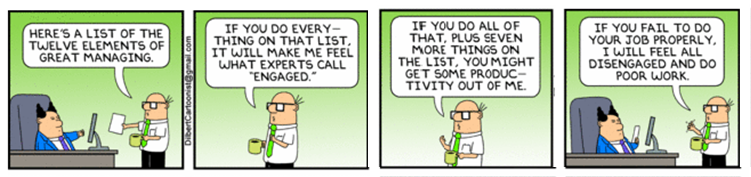
Employee engagement is defined as: ‘employees willingly contributing to the work while putting in intellectual effort, experiencing positive emotions at work and making meaningful connections to others at the workplace [[i]]. A study conducted by Gallup [[ii]] indicates that workplace engagement acts as a powerful catalyst for driving innovation within an organization and improves the business performance of the organization. People need to feel a purpose for what they do and build relationships in order to be entirely happy at work, and therefore more productive and creative. When employees are optimally engaged, they support the vision of the enterprise, put zeal and energy into their work and are most likely to contribute to innovations at workplace.  Higher engagement levels are associated with positive outcomes both at the individual and organizational levels. These outcomes include higher performance levels, lower employee attrition, less absenteeism and raised levels of personal well-being.

Disengaged versus Engaged Employees

There are significant differences in attitude of engaged and disengaged employees towards their work and in the way they view their work company's work practices.
  • Disengaged employees usually redirect opportunities and avoid ownership.
  • They view change as inconvenient and perceive feedback as a threat.
  • They complete tasks merely for compliance and put up excuses when things get difficult.
On the other hand,
  • Engaged employees own opportunities and improve contribution.
  • They look at change as a means for evolution and acknowledge feedback as a mechanism for improvement.
  • They complete task for contribution, and put in efforts when things get difficult.
An optimally engaged workforce results in more ‘fit-performers’ working towards building a more productive, more competitive and more a resilient organization.  However we also need to remember that when engagement is increased to excessively high levels, it might lead to ill-health and burnout of employees.

Drivers for Employee Engagement

The paper 'Creating An Engaged Workforce' indicates that the key factors that drive employee engagement are:
  • meaningful work,
  • clarity of objectives,
  • senior management communication style and vision,
  • person - job fit,
  • person- organization fit
  • line management style,
  • supportive work environment, and
  • employee voice.

In my next post I will discuss more about these drivers and what companies can do to create an 'Engaged Workforce'.


References :

[i] Creating An Engaged Workforce  by Kerstin Alfes, Catherine Truss, Emma C. Soane, Chris Rees and Mark Gatenby, January 2010
[ii] Gallup Study: Engaged Employees Inspire Company Innovation, The Gallup Management Journal, October 12, 2006